Not every commercial product requires the same traceability depth.
However, long-running B2B projects may benefit from the ability to identify:
Production batch
Material batch
BOM revision
PCB revision
Firmware version
Test status
This can make root-cause analysis easier if a problem appears after production.
Traceability requirements should be agreed according to the actual project rather than assumed.
Hardware and Software Capability Can Matter
Modern electronic power products increasingly combine power circuitry with embedded control.
Depending on the application, software or firmware can influence:
Charging logic
Communication
Protection behavior
Status indication
Motor control
Product configuration
Bolanda currently describes its ODM/OEM offering as including customized hardware and software support for electronic-power projects.
For buyers developing more advanced control products, software ownership, revision control, validation, and change-management responsibilities should be defined early.
Ask Who Owns the Technical Documentation
A mature OEM project should have controlled documents.
Depending on scope, these may include:
Product specification
BOM
PCB revision
Schematics
Connector drawing
Cable drawing
Firmware revision
Test specification
Packaging specification
The buyer should clarify:
Which documents are customer-owned?
Which are manufacturer-owned?
Which changes require approval?
Who maintains revisions?
Clear documentation reduces misunderstandings when the project moves from engineering into production.
Electronic Power OEM vs ODM: What Is the Difference?
The exact terminology varies across suppliers, but a practical distinction can be useful.
Project Type
Typical Starting Point
标题>
Standard product
Existing product with little or no change
OEM
Existing or customer-defined product customized for buyer requirements
ODM
Manufacturer contributes more product design or development
EMS/CM
Manufacturer builds according to defined customer manufacturing requirements
表>
Real projects can overlap these categories.
The more important question is not what label the supplier uses.
Ask:
Who is responsible for design, engineering changes, component selection, testing, and manufacturing?
Bolanda currently offers both OEM/ODM support and EMS/CM manufacturing services.
What Products Can an Integrated Electronic Power Manufacturer Support?
An integrated manufacturer can support different products through common electronics-manufacturing capabilities.
Bolanda's current portfolio illustrates several application categories.
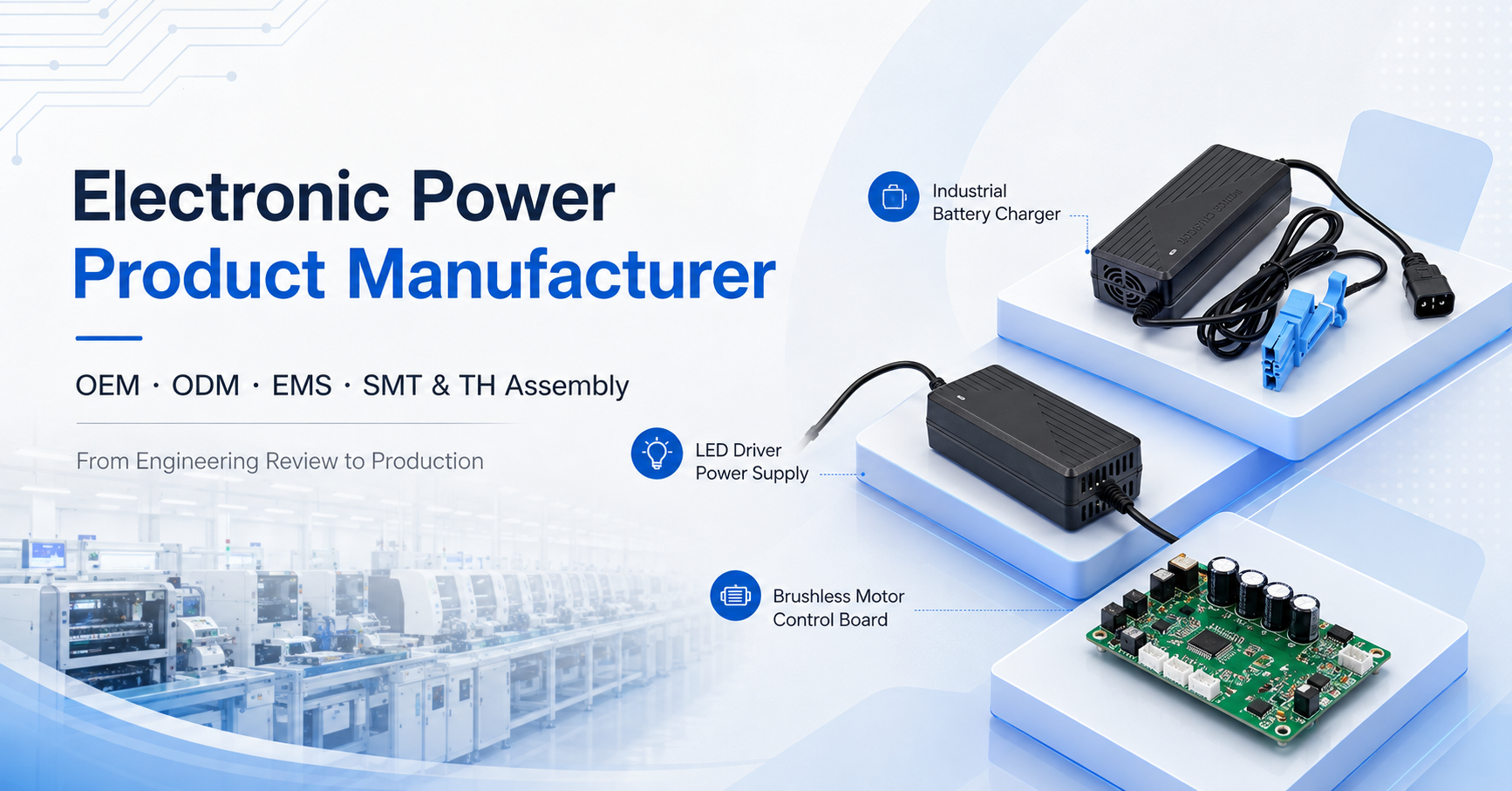
Power Tool Chargers
Charging electronics for power-tool battery applications.
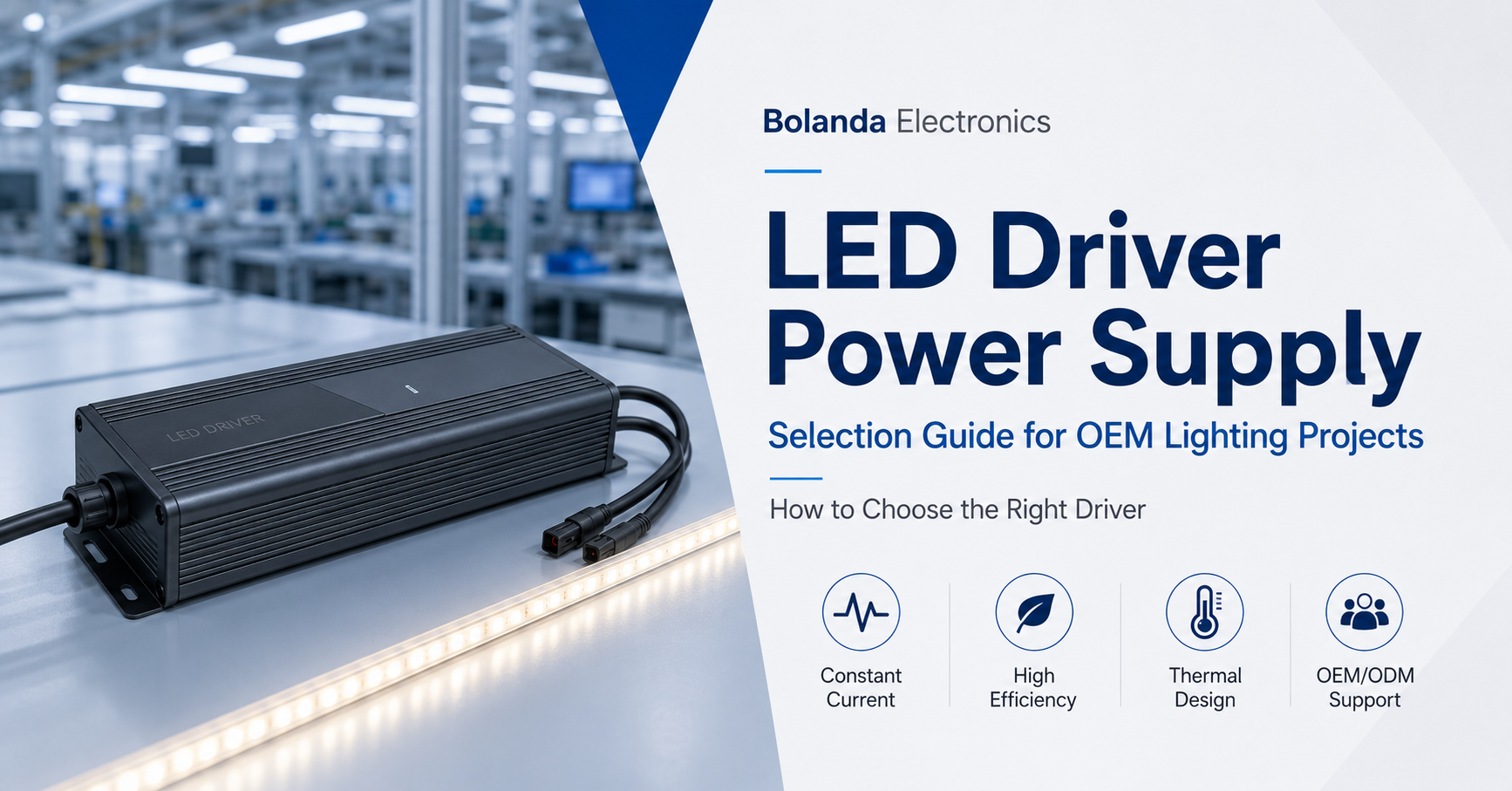
LED Driver Power Supplies
Power conversion for LED lighting applications.
Brushless Motor Control Boards
Electronic control boards for brushless-motor projects.
Logistics Lithium Equipment Chargers
Charging systems for logistics and material-handling equipment.
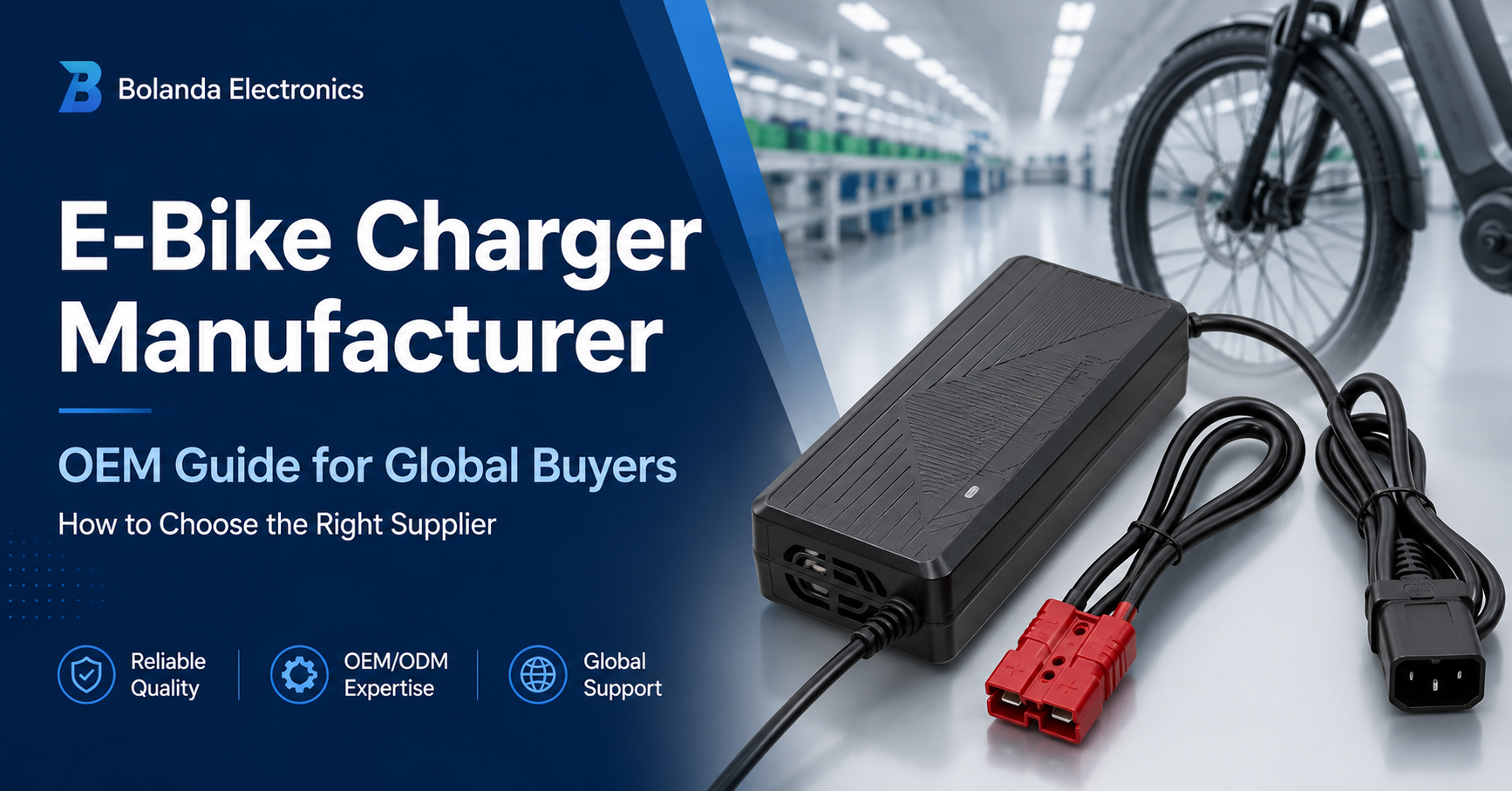
E-Bike and Motorcycle Chargers
Charging products for electric mobility applications.
These products have different electrical requirements but share manufacturing needs such as PCB assembly, components, testing, quality control, and supply-chain management.
Electronic Power Manufacturer Evaluation Checklist
Evaluation Area
What to Verify
标题>
Product experience
Relevant electronic power applications
Engineering
Can review electrical and application requirements
Hardware
Can support PCB/product engineering where required
Software
Can support control logic where applicable
SMT
Controlled surface-mount assembly
Through-hole
Capability for power and mechanical components
Components
Approved BOM and sourcing control
Prototypes
Structured sample process
Testing
Defined functional test requirements
Reliability
Application-specific verification
Quality
Incoming, process and final control
Standards
Can support agreed workmanship requirements
Documentation
Revision and specification control
Supply chain
Component continuity and alternatives
Change control
Customer review of important changes
OEM/ODM
Required customization scope
Production
Can transfer prototype into stable volume production
表>
This type of checklist is more useful than comparing factory size alone.
Common Sourcing Risks
Selecting a supplier based only on low price
Risk: Engineering, testing, component quality, or change-control requirements may be excluded.
Better approach: Compare the complete manufacturing scope.
Risk: Buyer and supplier may interpret “high quality” differently.
Better approach: Define inspection and acceptance criteria.
Asking for certifications without identifying the product
Risk: Certification scope may apply to a different model.
Better approach: Confirm compliance requirements against the exact product configuration. Bolanda itself states that certification availability and scope vary by product and target market.
What Information Should Be Included in an RFQ?
RFQ Item
Information to Provide
标题>
Product
Charger, LED driver, control board or other
Application
End equipment
Input
Electrical input requirements
Output
Voltage, current, power or control requirements
Load
Battery, LED, motor or other
Control
Required logic or communication
Environment
Temperature and use conditions
PCB
Existing design or development requirement
Connector
Model, drawing or sample
Housing
Mechanical requirements
Software
Firmware requirements if applicable
Quality
Inspection or workmanship requirements
Target market
Destination country/region
Forecast
Prototype and production quantity
OEM requirements
Branding, cable, label, packaging, etc.
表>
Bolanda recommends providing electrical specifications, application, connector, target market, and order quantity when submitting a project for review.
The more complete the RFQ, the easier it becomes to compare manufacturers on the same technical basis.
Frequently Asked Questions About Electronic Power Product Manufacturers
What does an electronic power product manufacturer make?
It can manufacture products that convert, regulate, charge, distribute, or control electrical power, such as battery chargers, LED drivers, power-control boards, and motor-control electronics. Bolanda's current portfolio includes these types of charger, driver, and control-board categories.
What should I evaluate before choosing a power electronics manufacturer?
The terms can overlap, but OEM generally focuses on manufacturing/customization for a buyer, ODM can involve more manufacturer-led development, while EMS/CM focuses on manufacturing services around defined product requirements. The exact responsibility split should be confirmed for each project.
Why are SMT and through-hole capabilities both useful?
Modern PCB assemblies use many surface-mount components, while electronic power products can also contain larger connectors, capacitors, transformers, terminals, or other through-hole components. Bolanda currently lists both SMT and TH assembly.
What is IPC-A-610?
IPC-A-610 is an electronics assembly acceptance standard covering acceptance requirements for electronic assemblies.
What is IPC J-STD-001?
IPC J-STD-001 provides requirements for soldered electrical and electronic assemblies and is widely used as an industry reference for soldering processes and materials.
Does every manufacturer need the same IPC class?
No. Required workmanship and acceptance criteria depend on the product and buyer requirements. If a specific IPC class or standard is required, it should be defined in the project documentation rather than assumed.
Can electronic power products be customized?
Customization depends on the manufacturer and platform. Bolanda currently reviews input/output, charging parameters, connectors and cables, housing and labels, plug standards, and packaging according to project requirements.
How should prototypes be approved?
Use defined electrical, functional, thermal, mechanical, and appearance criteria. Bolanda's published workflow places sample evaluation before project approval and production.
Does Bolanda support electronic power OEM projects?
Yes. Bolanda currently positions itself as an OEM/ODM electronic power manufacturer and provides EMS/CM, hardware/software support, SMT and through-hole assembly, reliability verification, and supply-chain coordination for B2B projects.