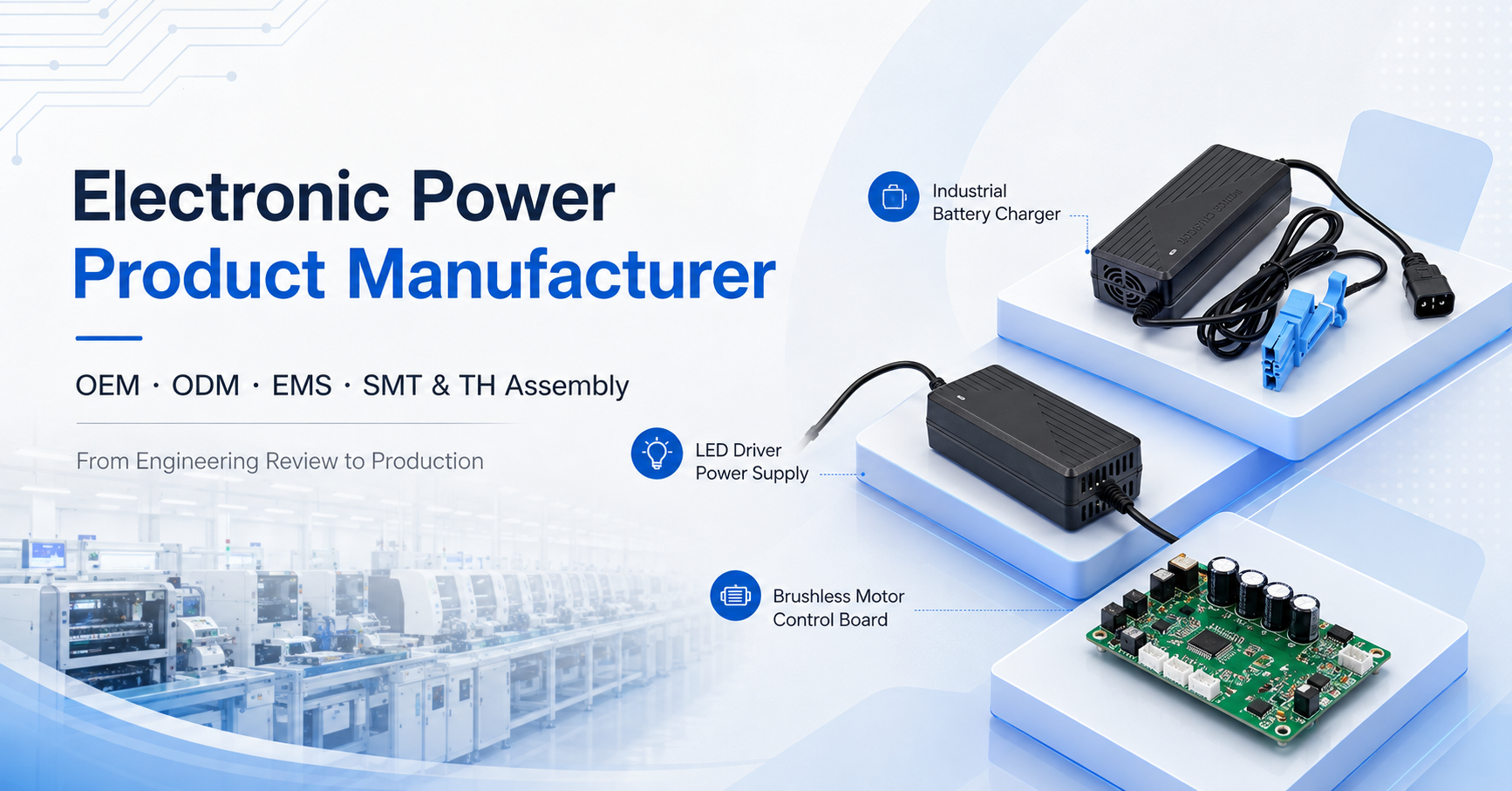
Bolanda specifically identifies logistics lithium equipment chargers among its core electronic power product categories.
What Should Be Tested During Sample Approval?
A charger sample should be tested as a complete charger and cable assembly.
Electrical Verification
Check:
Output voltage
Charging current
Charging profile
Charge termination
Connector Verification
Check:
Polarity
Pin arrangement
Contact engagement
Current capability
Mechanical fit
Thermal Verification
During representative charging cycles, evaluate:
Connector temperature
Cable temperature
Charger housing temperature
Unexpected connector heating can indicate issues involving contact resistance, termination, current, or cable selection.
Mechanical Verification
Repeat connection and disconnection.
Check:
Insertion force
Removal force
Connector retention
Cable strain relief
Keying
Housing durability
Battery Compatibility
Use the actual battery whenever practical.
The connector can be correct while the charging parameters remain incompatible.
OEM Customization for Quick Disconnect Charger Projects
Bolanda's current public OEM/ODM framework provides several relevant project-review areas.
Connector and Cable
This is directly relevant to quick disconnect charger projects.
The required connector and cable configuration can be reviewed against the selected charger and battery application.
Input and Output
Electrical parameters should match the battery and application.
Charging Parameters
Charging requirements can be evaluated according to the confirmed battery system.
Housing and Label
Product identification and branding requirements can be reviewed.
Plug Standard
AC-side configuration can be reviewed for the target market.
Packaging
OEM packaging can be defined around the confirmed project.
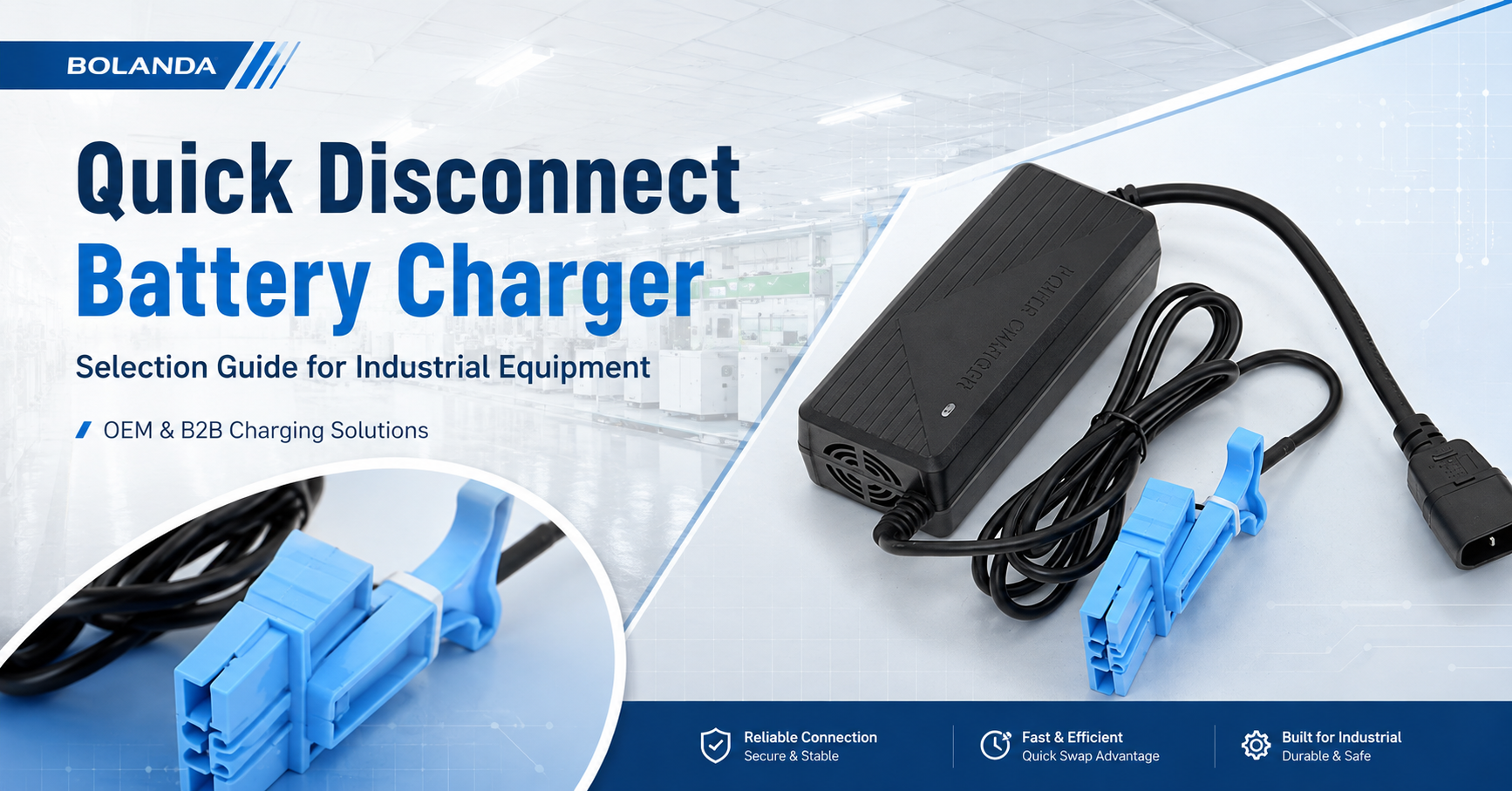
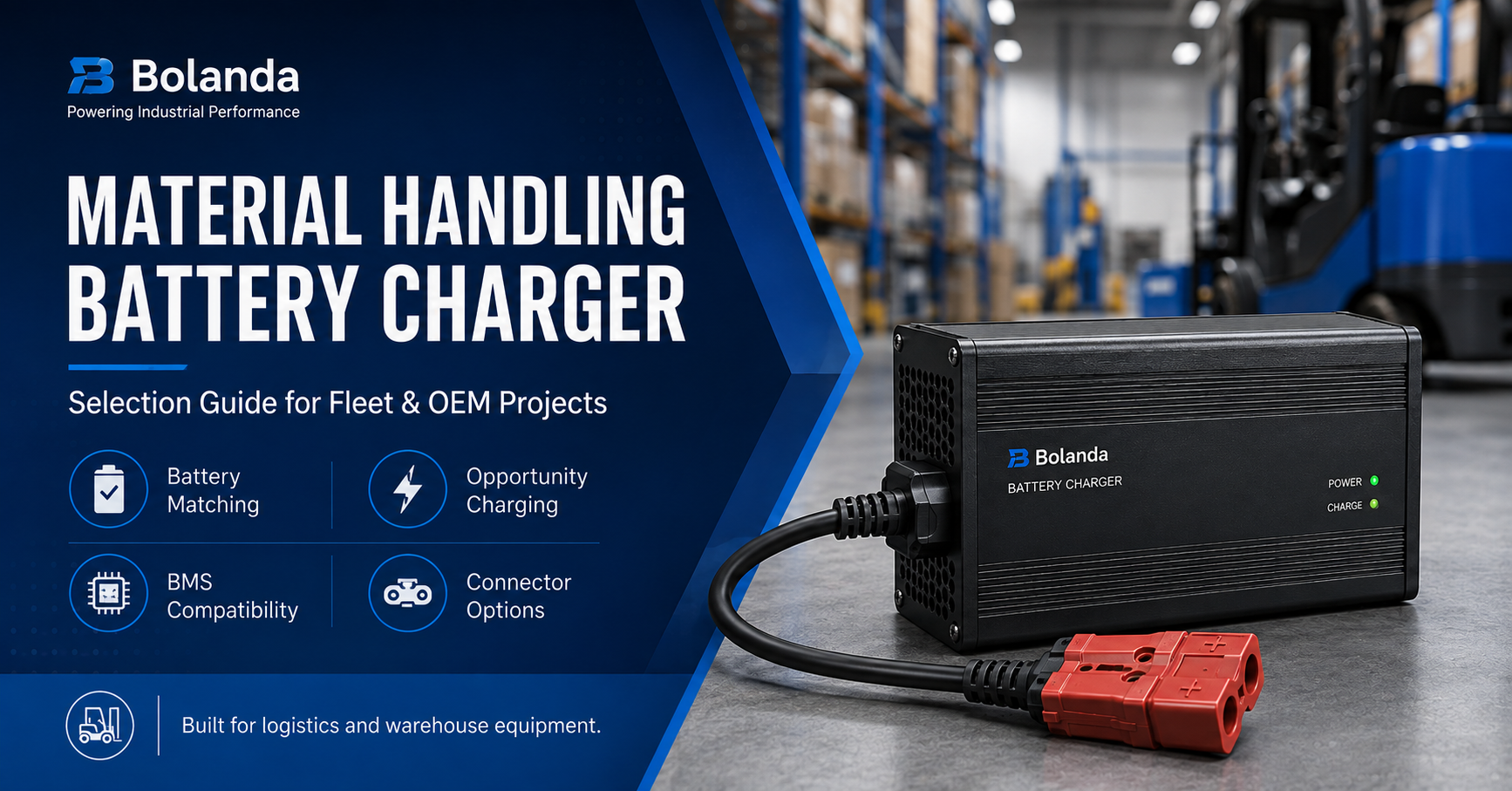
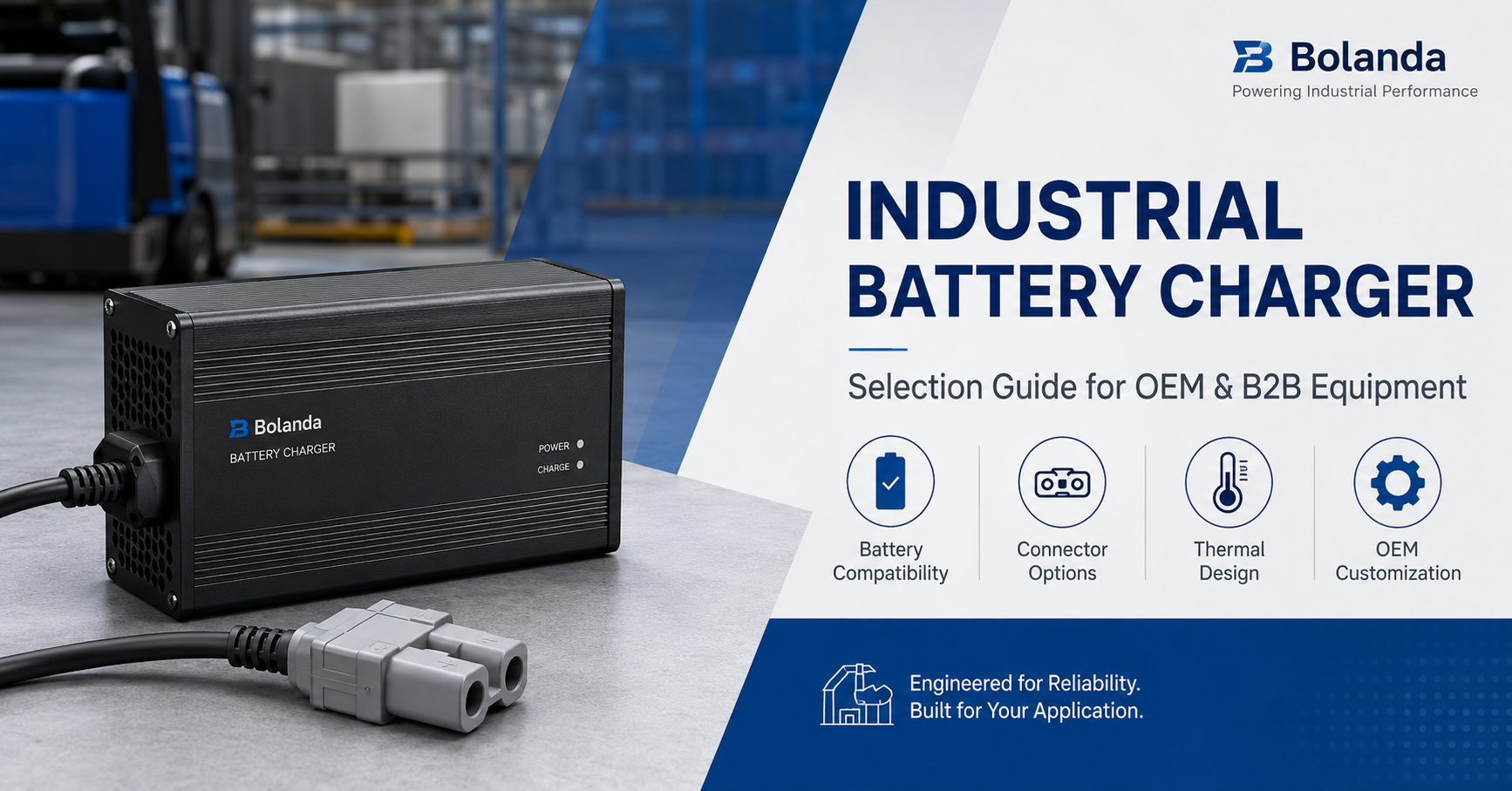
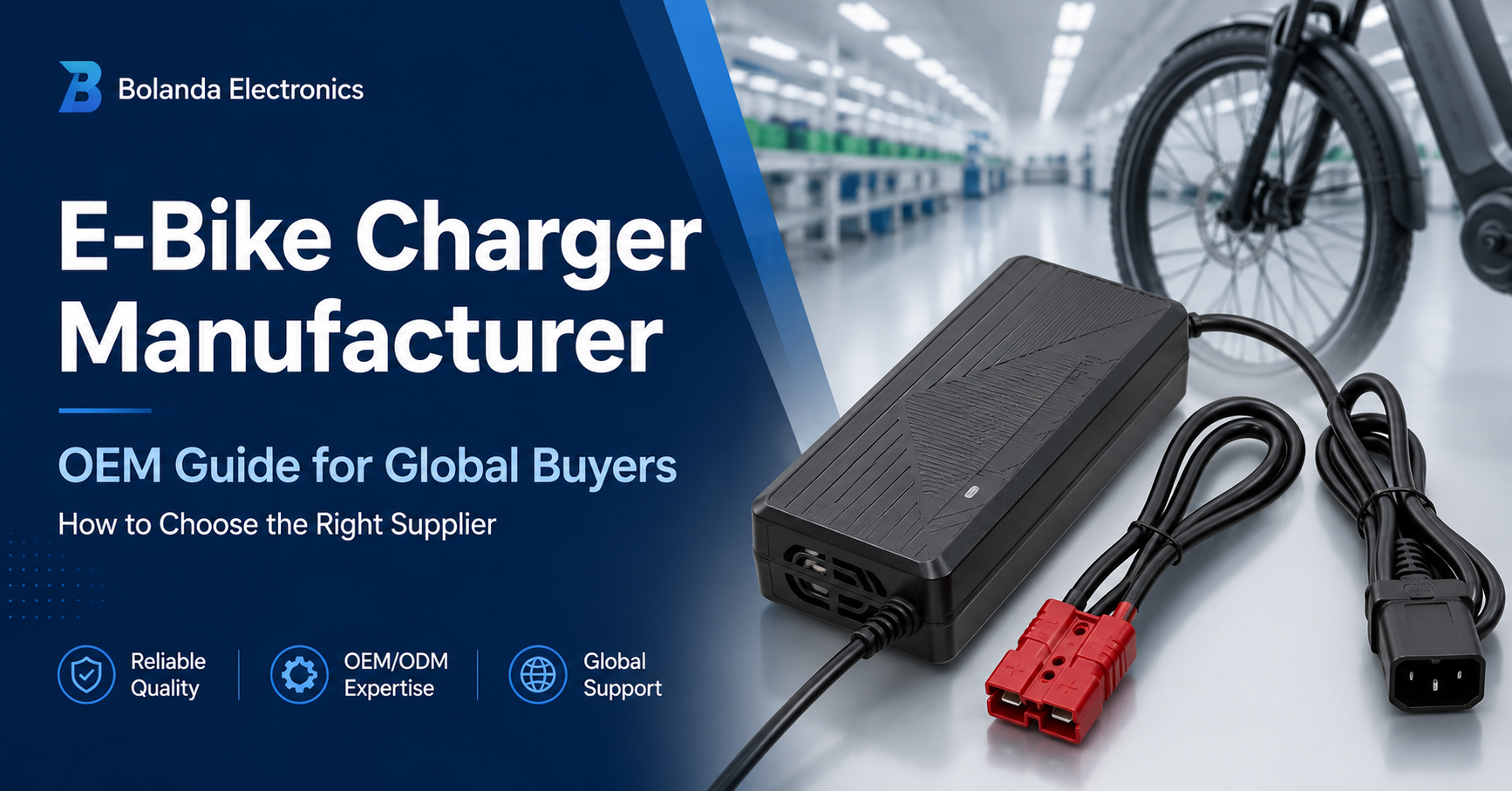
Bolanda currently displays compact industrial charger versions using red, gray, and blue two-pole connectors, giving buyers several existing product configurations as starting points for project evaluation.
Common Procurement Mistakes
Selecting from connector color only
Risk: Similar-looking connectors may have different keying or specifications.
Better approach: Confirm exact connector type and drawing.
Ignoring polarity
Risk: Incorrect polarity can create serious equipment or battery problems.
Better approach: Define pinout in the approved specification.
Choosing a connector with insufficient current capability
Risk: Excessive contact heating and voltage drop.
Better approach: Match the connector to actual charging current and operating conditions.
Ignoring cable size
Risk: The connector may be adequate while the cable is undersized.
Better approach: Validate the complete cable assembly.
Disconnecting under load without confirmation
Risk: The connector may not be designed to interrupt charging current.
Better approach: Define the correct disconnect procedure or interlock strategy.
Assuming the BMS only needs two wires
Risk: Some battery systems require signal or communication contacts.
Better approach: Confirm BMS interface requirements before selecting the connector.
What Information Should You Send in the RFQ?
RFQ Item
Information to Provide
标题>
Application
Equipment or battery system
Battery chemistry
Exact chemistry
Nominal voltage
Battery system voltage
Charging voltage
Required final charging voltage
Charge current
Target and maximum
Battery capacity
Ah or Wh
BMS
Interface requirements
Connector
Part number, photo, drawing or sample
Polarity
Positive and negative terminals
Cable
Length and conductor requirement
Mating frequency
Estimated connection cycles
Environment
Temperature, dust, moisture
Input
AC requirements
Plug
Target-market requirement
Quantity
Prototype and production forecast
表>
Bolanda's current quotation guidance asks buyers to provide product type, input and output requirements, battery information, connector, estimated quantity, and target market.
For this type of project, providing an actual connector sample can make the evaluation substantially more reliable.
Frequently Asked Questions About Quick Disconnect Battery Chargers
What is a quick disconnect battery charger?
It is a battery charger equipped with a connector intended to make charger-to-battery connection and disconnection convenient. The exact connector still needs to match the battery's voltage, current, polarity, cable, and interface requirements.
Are red and blue battery connectors interchangeable?
Not automatically. In some connector families, colors can correspond to different keyed configurations. The exact connector part number and mechanical keying should be confirmed rather than relying on color. Anderson's SB family is one example where colored keyed housings are used to prevent cross-mating.
What does a two-pole battery connector mean?
A basic two-pole connector provides two main electrical contacts, normally positive and negative power. Battery systems requiring communication or sensing may need additional contacts.
How do I select connector current rating?
Start with the maximum charger current and verify the selected connector, contacts, cable size, termination, ambient conditions, and duty cycle against their actual ratings.
Can a quick disconnect connector be disconnected while charging?
Not necessarily. Some connectors are specifically rated for current interruption, but many should not be assumed to have that capability. Confirm the connector specification and charger operating procedure.
Why does the connector become warm during charging?
Potential causes can include contact resistance, high current, poor termination, undersized cable, damaged contacts, or an unsuitable connector. The cause should be investigated rather than assuming heating is normal.
Can Bolanda provide different connector colors?
Bolanda currently displays compact industrial charger products with red, blue, and gray two-pole connector configurations. Exact availability and compatibility should be confirmed for the selected product.
Can the connector and cable be customized?
Bolanda lists connector and cable requirements within its current OEM/ODM project-review framework. Final feasibility depends on the selected charger, electrical requirements, connector, and order scope.
Can charging voltage and current also be customized?
Bolanda currently lists input/output and charging parameters as project configuration areas, but the final specification must be confirmed through technical review.
What should I send before requesting a quotation?
Provide battery chemistry, voltage, current, capacity, BMS information, connector part number or sample, cable requirements, application, environment, target market, and estimated quantity.