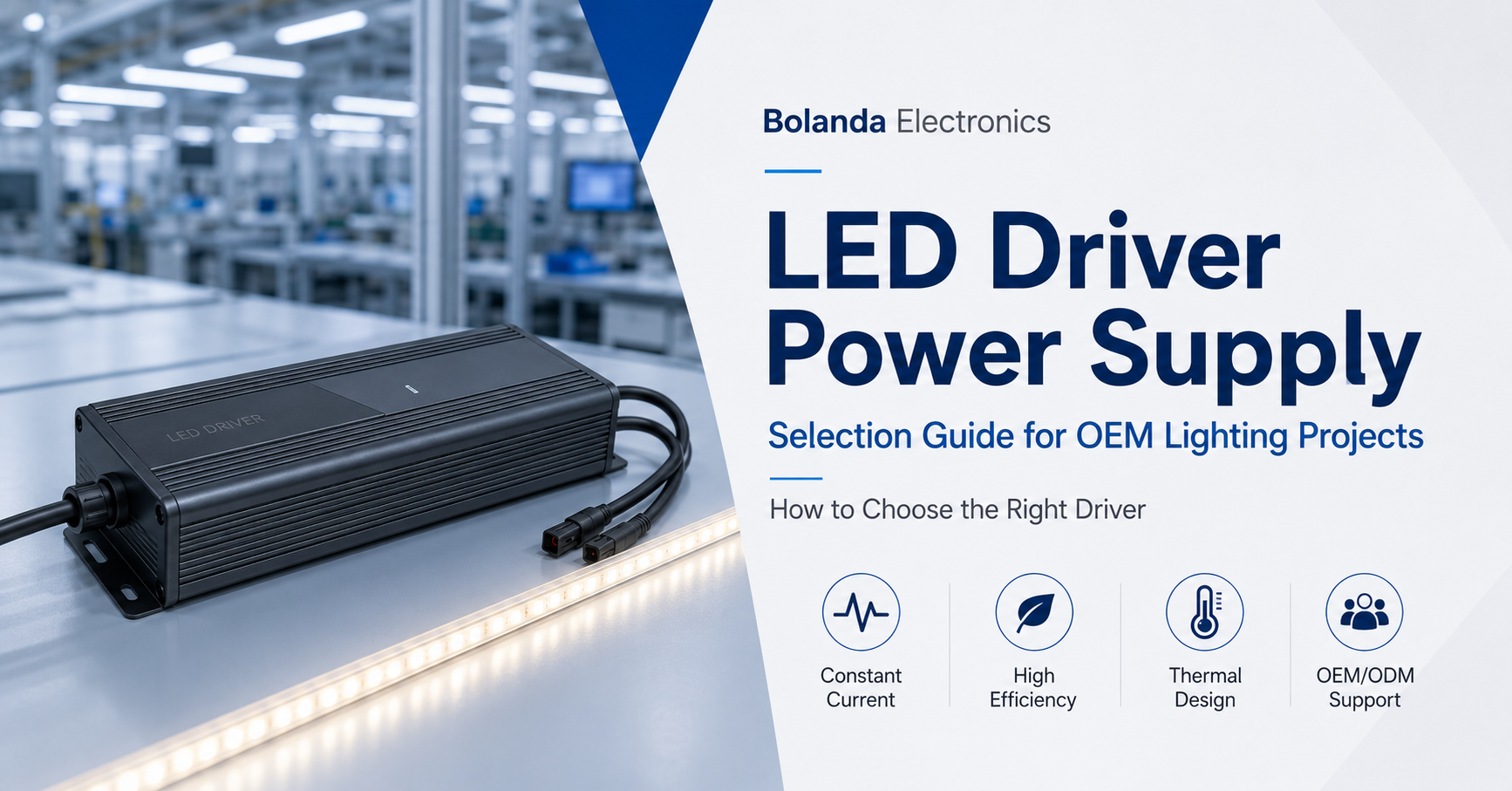
What Is an LED Driver Power Supply?
An LED driver power supply converts and regulates electrical power so an LED load can operate within its intended electrical limits.
Unlike a conventional load that may simply require a fixed supply voltage, LEDs are strongly influenced by current. Analog Devices notes that constant-current driving helps prevent excessive current while also producing more predictable LED brightness and color characteristics.
For an OEM lighting project, the driver should therefore be selected around the LED module rather than by wattage alone.
The buyer should understand:
- LED operating current
- LED forward-voltage range
- Total LED configuration
- Required driver output range
- Maximum power
- Dimming requirement
- Operating temperature
- Installation environment
- Mechanical space
- Target market
These factors determine whether a driver is technically suitable for the luminaire.
Start With the LED Load, Not the Driver Catalog
One of the most effective ways to reduce LED driver selection errors is to begin with the actual LED load specification.
A useful project brief should include:
| LED Load Information | Why It Matters |
|---|---|
| LED type or module | Defines the electrical load |
| Forward-voltage range | Helps establish driver output-voltage needs |
| Rated current | Defines required regulated LED current |
| Number of LEDs | Influences total voltage and power |
| Series/parallel configuration | Changes driver requirements |
| Maximum power | Helps define driver capacity |
| Dimming requirement | Influences control-interface selection |
| Operating environment | Affects thermal design |
| Luminaire type | Influences mechanical and safety requirements |
A request such as:
“I need a 50W LED driver.”
is usually incomplete.
Two 50W LED systems may require very different combinations of voltage, current, dimming, enclosure design, and protection.
Constant Current vs Constant Voltage LED Drivers
This is one of the most important decisions in LED driver selection.
Constant Current LED Driver
A constant current LED driver regulates the current supplied to the LED load.
This approach is widely used when the LED module is designed around a defined operating current.
Analog Devices explains that constant-current regulation helps maintain LED current despite variations in factors such as LED forward voltage.
Typical applications may include:
- LED luminaires
- Downlights
- Spotlights
- High-power LED modules
- Architectural lighting
- Integrated LED fixtures
The buyer should provide both the required current and the expected LED forward-voltage range.
Constant Voltage LED Power Supply
A constant-voltage supply regulates output voltage rather than directly controlling LED current.
This approach can be appropriate when current regulation already exists within the LED load, such as in certain LED modules, strips, or systems with downstream regulation.
The important point is that constant-current and constant-voltage products are not automatically interchangeable.
The correct choice depends on how the LED module itself is designed.
How to Specify LED Driver Output Current
For a constant-current driver, LED current is one of the primary specifications.
The driver current should match the LED module's intended operating current.
A higher current may produce more light in some LED systems, but increasing current beyond the LED manufacturer's limits can affect:
- Junction temperature
- Thermal load
- Light output stability
- Color behavior
- Reliability
Analog Devices specifically identifies limiting current as a reason to use constant-current LED driving.
For an OEM project, buyers should therefore avoid choosing current only according to a desired brightness target.
Use the LED manufacturer's electrical and thermal specification as the design basis.
How to Determine the Required Output Voltage Range
For a constant-current LED driver, output voltage often needs to operate across a range rather than at one exact value.
LED forward voltage can vary according to:
- LED type
- Number of LEDs in series
- Temperature
- Manufacturing variation
- Operating current
If multiple LEDs are connected in series, their forward voltages combine.
The driver therefore needs enough output-voltage capability to regulate current across the expected LED string range.
A useful RFQ should provide:
- Minimum expected LED voltage
- Typical LED voltage
- Maximum expected LED voltage
- Required LED current
This gives the driver manufacturer more useful information than a single nominal voltage.
How Much Driver Wattage Is Needed?
Driver power should be evaluated from the electrical load.
For a simplified planning estimate:
LED power ≈ LED voltage × LED current
However, driver selection should not rely on a theoretical wattage calculation alone.
Engineering review should also consider:
- Maximum LED voltage
- Maximum operating current
- Driver operating range
- Efficiency
- Thermal conditions
- Dimming behavior
- Application requirements
A driver should not be selected simply because its maximum advertised wattage equals the nominal LED wattage.
The operating point needs to fall within the manufacturer's approved electrical range.
Why Driver Topology Matters
Different LED applications can require different power-conversion approaches.
Depending on input and output conditions, common converter architectures can include:
- Buck
- Boost
- Buck-boost
- Flyback
- Other isolated or non-isolated architectures
Analog Devices notes that boost, buck-boost, SEPIC and high-side buck architectures can all be used in LED driver designs depending on electrical requirements.
For a B2B buyer, it is usually unnecessary to specify a converter topology unless the project requires it.
Instead, provide the application requirements and allow engineering to determine an appropriate architecture.
Dimming Requirements Should Be Defined Early
Dimming is not one universal function.
Different lighting systems may require different control methods.
Potential requirements can include:
- PWM dimming
- Analog dimming
- External control signals
- Application-specific dimming interfaces
Texas Instruments describes both analog and PWM dimming approaches within LED driver applications.
PWM dimming controls light intensity by changing the proportion of time the LED operates at its regulated current. TI also notes that driver bandwidth can affect achievable PWM dimming performance.
For an OEM project, the buyer should therefore specify:
- Whether dimming is required
- Control method
- Dimming range
- Control-signal requirements
- Flicker requirements
- Application environment
These requirements should be confirmed during sample validation rather than added after the PCB design is complete.
Why Low-End Dimming Performance Matters
A driver that can technically dim may still perform poorly at very low brightness levels.
Potential project concerns include:
- Flicker
- Unstable current
- Visible stepping
- Uneven startup
- Dimming dead zones
- Inconsistent behavior between units
For applications such as:
- Architectural lighting
- Hospitality lighting
- Display lighting
- Studio or video environments
- Premium residential lighting
dimming quality may be an important product attribute.
The required performance should therefore be included in the project specification.
Thermal Design Is Critical in LED Driver Projects
LED drivers are power-conversion devices and generate heat during operation.
Thermal conditions can influence:
- Component stress
- Driver lifetime
- Output behavior
- Protection activation
- Enclosure temperature
- Overall luminaire reliability
Analog Devices notes that inefficient power regulation can convert excess electrical energy into heat, demonstrating why efficiency and thermal design are linked in LED systems.
Important thermal inputs include:
- Ambient temperature
- Driver mounting location
- Enclosure size
- Airflow
- Luminaire temperature
- Maximum output power
- Duty cycle
Testing a driver on an open laboratory bench may not represent its behavior inside a compact sealed luminaire.
Efficiency Should Be Evaluated at the Actual Operating Point
Driver efficiency affects:
- Power consumption
- Heat generation
- Thermal requirements
- System performance
However, buyers should avoid evaluating efficiency using only a single headline figure.
Ask:
- At what input voltage was efficiency measured?
- At what output load?
- At what temperature?
- Is the figure typical or guaranteed?
- How does efficiency change across the load range?
A driver that performs efficiently near full load may behave differently at another operating point.
For an OEM project, evaluation should focus on the actual LED load.
Power Factor and Input Requirements
For AC-powered LED drivers, input-side electrical performance can also matter.
Depending on application and target market, buyers may need to define:
- AC input-voltage range
- Frequency
- Power factor requirements
- Inrush-current requirements
- Harmonic requirements
- Standby behavior
These requirements should be established before final electrical design.
Do not assume that all drivers with the same output wattage have identical input characteristics.
Isolated vs Non-Isolated LED Drivers
Isolation is another project-level consideration.
An isolated architecture electrically separates input and output through an isolation barrier.
A non-isolated architecture may offer different benefits in cost, size, efficiency, or design complexity, depending on the application.
The correct architecture depends on:
- Luminaire construction
- Accessible parts
- System grounding
- Safety requirements
- Mechanical design
- Applicable standards
This decision should be made with the complete luminaire design in mind rather than treating the driver as an isolated component choice.
What Protection Functions Should Be Discussed?
Protection features depend on the LED driver architecture and intended application.
Relevant engineering discussions can include:
- Output overvoltage behavior
- Output overcurrent behavior
- Short-circuit behavior
- Overtemperature protection
- Open-load behavior
- Input abnormal conditions
- Fault recovery
Not every product uses the same protection strategy.
Therefore, the buyer should include required fault conditions in the technical specification and validate them during sampling.
Indoor and Outdoor LED Driver Requirements Are Different
Installation environment influences driver design.
Indoor Applications
Potential concerns include:
- Compact size
- Low noise
- Dimming quality
- Thermal interaction with the luminaire
- Aesthetic integration
Outdoor Applications
Projects may additionally need to consider:
- Moisture
- Dust
- Temperature variation
- Mechanical sealing
- Installation conditions
Environmental protection should be evaluated for the complete product configuration rather than inferred from appearance alone.
What Should Be Tested During LED Driver Sampling?
A sample should be treated as an engineering prototype.
Electrical Verification
Check:
- Input range
- Output current
- Output-voltage range
- Output power
- Startup behavior
- Shutdown behavior
- No-load or abnormal-load behavior
LED Compatibility
Connect the driver to the actual target LED module whenever practical.
Confirm:
- Stable operation
- Correct current
- Brightness
- Startup
- Dimming
- Thermal behavior
Dimming Validation
If dimming is required, test:
- Maximum brightness
- Minimum brightness
- Smoothness
- Flicker
- Startup at low dimming levels
- Control response
TI notes that LED driver design and control-loop behavior affect PWM dimming capability, reinforcing the need to test the actual driver and LED combination.
Thermal Evaluation
Operate the driver under representative conditions and evaluate relevant temperatures.
Include the actual enclosure or luminaire where possible.
Mechanical Evaluation
Confirm:
- Driver dimensions
- Mounting points
- Cable direction
- Connector configuration
- Housing
- Installation clearance
OEM LED Driver Customization Options
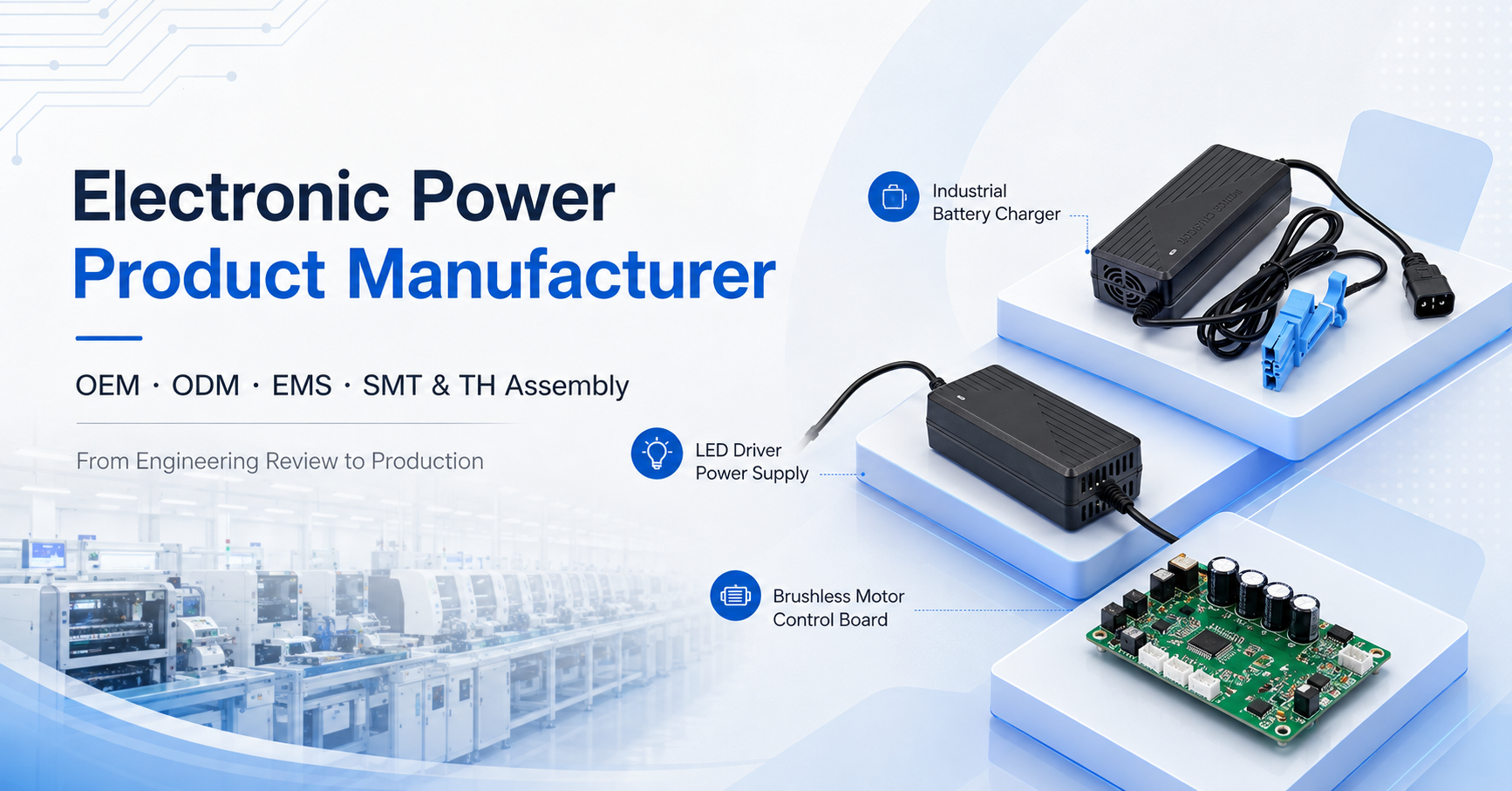
Bolanda currently identifies LED Driver Power Supplies as one of its core electronic power product categories.
For OEM/ODM electronic power projects, its published customization framework includes several areas.
Input and Output
Electrical parameters can be reviewed around the selected product and application.
Product Parameters
For an LED driver project, the required electrical operating conditions should be reviewed against the selected platform and technical feasibility.
Connector and Cable
Projects may require different:
- Cable lengths
- Input leads
- Output leads
- Connector configurations
Bolanda lists connector and cable requirements among its general OEM/ODM customization areas.
Housing and Label
Private-label projects may require:
- Logo
- Product label
- Identification
- Housing-related changes where feasible
Bolanda also lists housing and label requirements within its customization framework.
Packaging
OEM packaging requirements can be evaluated according to the final project and order requirements.
Final feasibility should always be confirmed after technical review rather than assumed from a general customization list.
Evaluate the Manufacturer's Electronics Production Capability
An LED driver is a power-electronics product.
Manufacturing capabilities can therefore influence consistency.
Relevant capabilities may include:
- SMT assembly
- Through-hole assembly
- Component sourcing
- PCB assembly
- Final assembly
- Functional verification
- Reliability testing
- Packaging
Bolanda states that it supports surface-mount and through-hole assembly for prototype and production orders. It also provides EMS and contract manufacturing support for electronic power projects.
For OEM buyers, integrated production can simplify coordination between engineering, component sourcing, PCB assembly, verification, and final delivery.
How Should LED Driver Quality Be Controlled?
A useful quality system should have defined control points rather than generic “strict QC” claims.
Bolanda currently describes four stages in its quality approach:
Material Review
Project-specific incoming components are reviewed before production use.
Process Inspection
Assembly and production checkpoints are arranged according to approved manufacturing requirements.
Product Verification
Functional and reliability verification is defined for the relevant product and project.
Release & Delivery
Final inspection, packaging, and delivery follow the confirmed quality plan.
For an LED driver project, this means the approved electrical and mechanical specification should become the basis for production verification.
Component Selection and BOM Control Matter
LED driver performance depends on electronic components such as:
- Power semiconductors
- Control ICs
- Capacitors
- Magnetic components
- Resistors
- Connectors
- PCB materials
For long-term OEM programs, ask:
- Is the BOM controlled?
- Which components are critical?
- Can substitutions occur without approval?
- How are alternatives validated?
- How are engineering changes documented?
Bolanda lists material coordination and component-alternative support as part of its supply-chain services.
This is particularly important when a lighting product remains in production for several years.
LED Driver Selection Checklist
| Selection Area | Key Question |
|---|---|
| Driver type | Constant current or constant voltage? |
| LED current | What current does the LED module require? |
| Voltage range | What is the LED forward-voltage range? |
| Power | What is the maximum operating power? |
| Input | What AC or DC input is required? |
| Dimming | Is dimming required and by which method? |
| Thermal | What is the actual installation temperature? |
| Protection | Which abnormal conditions need to be covered? |
| Mechanical | What size and mounting constraints exist? |
| Cables | What input/output cable configuration is required? |
| Environment | Indoor or outdoor application? |
| Target market | Where will the luminaire be sold? |
| OEM needs | Logo, label, housing or packaging? |
| Validation | How will samples be approved? |
A buyer who can answer these questions is much more likely to receive a technically meaningful quotation.
Common LED Driver Sourcing Mistakes
Choosing by wattage only
Risk: Output current or voltage range may not match the LED module.
Better approach: Define current, voltage range and actual LED configuration.
Using constant voltage where constant current is required
Risk: LED current may not be controlled as intended.
Better approach: Confirm whether current regulation exists in the LED module.
Ignoring minimum and maximum LED voltage
Risk: The driver may operate outside its regulation range.
Better approach: Provide the complete forward-voltage range.
Adding dimming after the driver is selected
Risk: The existing driver architecture may not support the required control method.
Better approach: Define dimming at the beginning of the project.
Testing outside the luminaire only
Risk: Real enclosure temperatures may be substantially different.
Better approach: Perform representative thermal validation.
Selecting by the lowest unit price
Risk: Important engineering, component, testing, or reliability requirements may be excluded.
Better approach: Compare total technical scope and lifecycle risk.
What Information Should Be Included in an LED Driver RFQ?
| RFQ Item | Information to Provide |
|---|---|
| Application | Luminaire or LED product type |
| LED configuration | Series and parallel arrangement |
| LED current | Required operating current |
| Voltage range | Minimum and maximum LED voltage |
| Power | Nominal and maximum |
| Input | AC/DC input specification |
| Dimming | Method and performance requirement |
| Environment | Indoor/outdoor and temperature |
| Mechanical size | Maximum driver dimensions |
| Cable | Input/output cable requirements |
| Connector | Drawing or specification |
| Housing | Standard or custom requirement |
| Branding | Logo and label |
| Target market | Destination country/region |
| Quantity | Sample and production forecast |
Bolanda's current project guidance asks buyers to provide electrical specifications, application, connector, target market, and order quantity for technical review.
Frequently Asked Questions About LED Driver Power Supplies
What is the difference between an LED driver and a power supply?
An LED driver is designed around LED load behavior and often regulates LED current. A general power supply commonly focuses on maintaining a defined voltage. The required architecture depends on the LED module.
Should I use a constant-current or constant-voltage LED driver?
Use the configuration required by the LED load. Integrated LED modules frequently require regulated current, while some LED products include their own downstream current regulation and use a constant-voltage supply.
How do I choose the correct LED driver current?
Follow the LED module or LED manufacturer's rated operating current and thermal limits. Constant-current regulation is commonly used to prevent excessive LED current and maintain predictable output.
How do I select LED driver voltage?
Determine the minimum and maximum forward voltage of the complete LED string at the required current and ensure that range is compatible with the driver's regulated output range.
Can I use a higher-wattage LED driver?
Potentially, provided the driver's current, voltage range, control method and application requirements remain compatible. Wattage alone does not determine suitability.
What does PWM dimming mean?
PWM dimming controls LED brightness by rapidly switching the LED current on and off and changing the duty cycle. TI documents PWM as a common LED dimming technique.
Why does LED driver temperature matter?
Higher temperature can increase stress on power electronics and other components. The driver should therefore be evaluated inside or under conditions representative of the final luminaire.
Can LED driver electrical parameters be customized?
Depending on the existing platform and technical feasibility, project-specific electrical requirements can be evaluated. Bolanda reviews input/output requirements against the selected electronic power product and application.
Can cables, labels and packaging be customized?
Bolanda currently lists connector and cable, housing and label, and packaging among its OEM/ODM project configuration areas. Final feasibility depends on the selected product and order requirements.
What should I send before requesting an LED driver quotation?
Provide LED current, voltage range, maximum power, input requirements, dimming requirements, operating environment, mechanical size, connector/cable requirements, target market, estimated quantity, and any OEM requirements.