What Is an Industrial Battery Charger?
An industrial battery charger is designed to provide controlled charging power to rechargeable batteries used in equipment such as logistics vehicles, material-handling systems, service equipment, mobile industrial machines, powered carts, and other battery-operated applications.
For B2B buyers, the charger should not be considered a separate accessory.
It operates as part of a system that can include:
- Battery cells
- Battery management system
- Charging connector
- Cable assembly
- Equipment interface
- Charging logic
- Thermal protection
- Mechanical housing
- Application-specific operating conditions
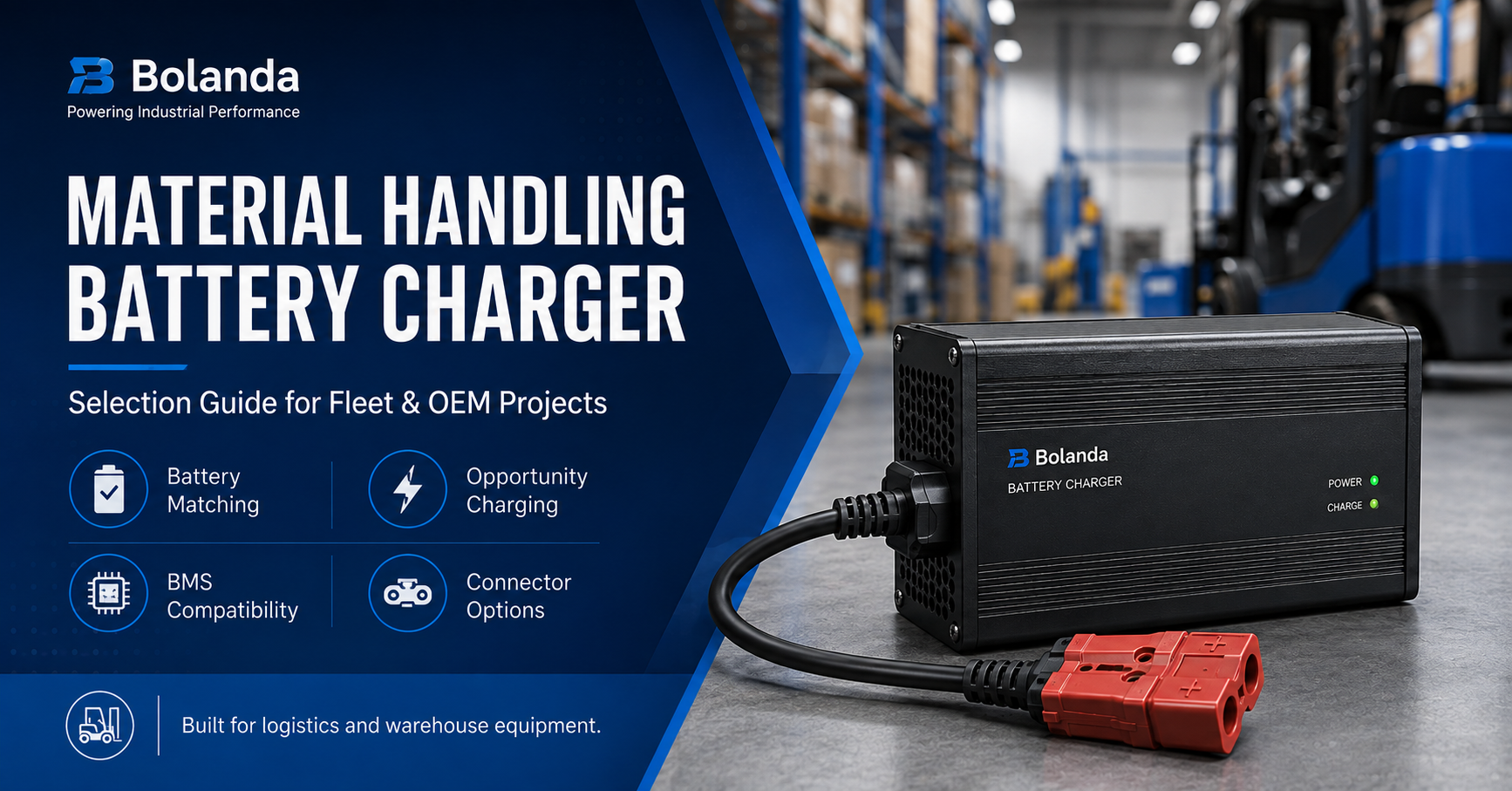
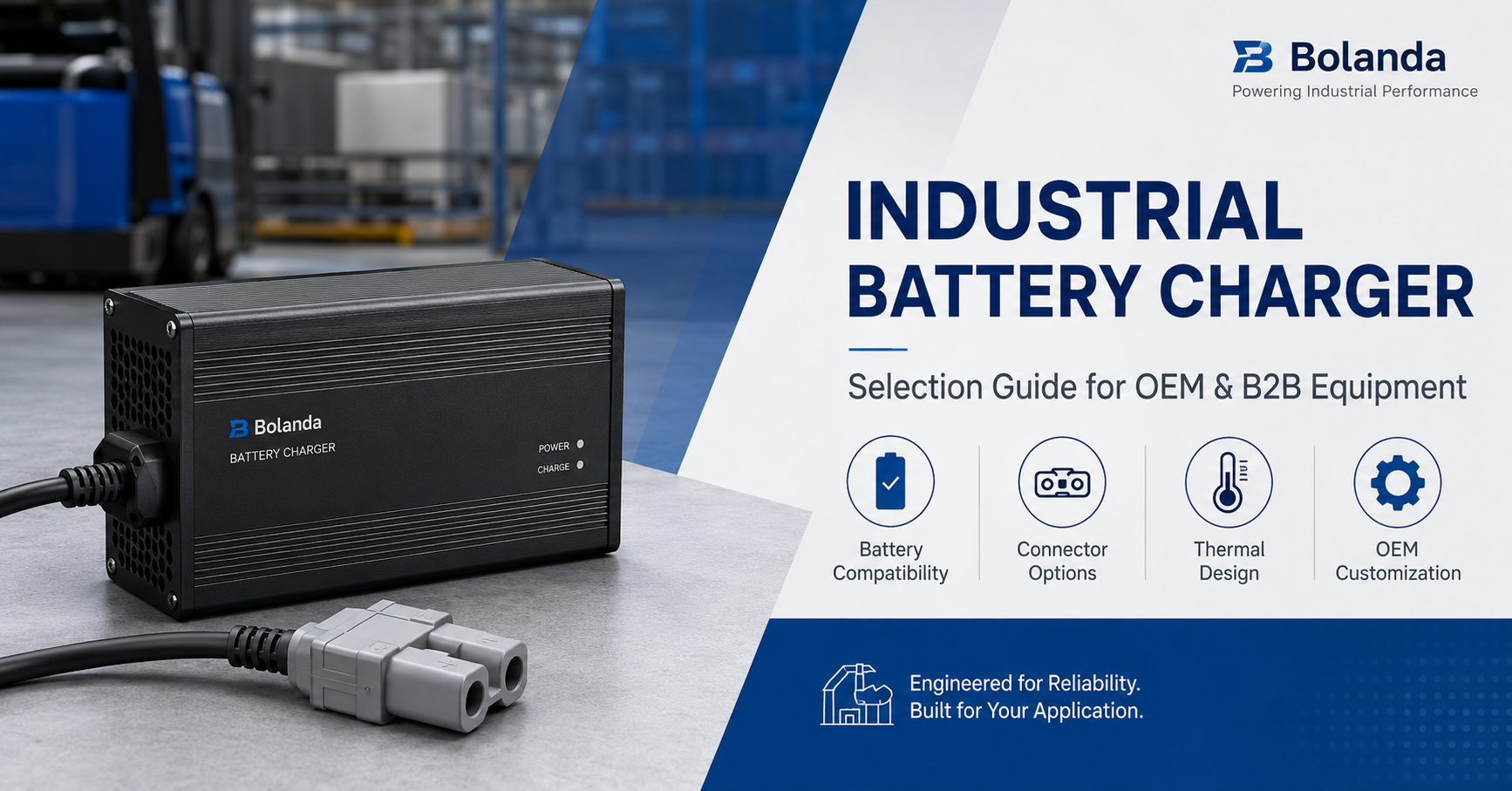
Bolanda currently lists Logistics Lithium Equipment Chargers as one of its five core electronic-power product categories and publicly displays several compact industrial charger models using red, gray, and blue two-pole connector configurations.
That makes battery and equipment compatibility the starting point for charger selection.
Start With the Battery Specification
Before requesting an industrial charger quotation, define the battery as accurately as possible.
A useful technical brief should include:
| Battery Requirement | Why It Matters |
|---|---|
| Battery chemistry | Determines the charging profile |
| Cell configuration | Helps establish charging voltage |
| Nominal voltage | Identifies the battery platform |
| Maximum charge voltage | Defines an important charger limit |
| Battery capacity | Influences charging-current selection |
| Maximum charge current | Defines a battery-side boundary |
| BMS requirements | May affect protection or communication |
| Temperature conditions | Can influence charging behavior |
| Connector pinout | Determines electrical compatibility |
| Application | Defines operating and mechanical requirements |
A request such as:
“We need a 48V industrial charger.”
may therefore be insufficient for an OEM project.
The charger manufacturer may still need to understand battery chemistry, full-charge voltage, BMS behavior, connector configuration, required charging current, operating environment, and actual equipment use.
Nominal Battery Voltage Is Not the Complete Charger Specification
Nominal voltage is useful for categorizing battery systems, but it should not automatically be treated as the required charger output.
For lithium batteries in particular, charging behavior is defined around the cell and pack charging limits.
Analog Devices describes lithium-ion charging as commonly requiring a constant-current and constant-voltage charging algorithm, in which current is initially regulated and the charger later maintains a defined voltage limit.
An industrial charger RFQ should therefore ideally identify:
- Nominal battery voltage
- Maximum charging voltage
- Battery chemistry
- Series cell configuration
- Maximum charge current
- BMS requirements
This gives the manufacturer a much stronger basis for evaluating compatibility.
How Does CC/CV Charging Work for Lithium Industrial Batteries?
For many lithium-ion battery systems, the charger uses CC/CV charging, meaning constant current followed by constant voltage.
Constant Current Stage
During the first major charging phase, the charger supplies a controlled current while battery voltage rises.
Constant Voltage Stage
When the battery approaches its defined charging-voltage limit, the charger regulates voltage and charging current progressively decreases.
Analog Devices describes this transition as a fundamental characteristic of Li-ion charging.
For industrial buyers, this means that charger current and charger voltage must be selected together.
A charger should not be approved simply because the maximum voltage printed on the label looks similar to the battery platform.
How to Choose Industrial Charger Current
Charging current affects both operating efficiency and system stress.
Higher charging current can reduce charging time, but it can also affect:
- Battery temperature
- Charger temperature
- BMS limits
- Connector current
- Cable size
- Component selection
- Thermal design
- Charging-cycle behavior
The correct current should be evaluated against the battery manufacturer's specifications and the requirements of the complete equipment system.
Important questions include:
- What is the battery's maximum permitted charging current?
- How quickly must the equipment return to service?
- Is overnight charging acceptable?
- Will the equipment be charged several times per day?
- What is the ambient temperature?
- What current can the connector and cable safely support?
- Does the existing charger platform support the required power?
The best industrial charger is therefore not automatically the model with the highest current.
It is the charger that meets the operational requirement while remaining compatible with the battery and electrical system.
Duty Cycle Matters in Industrial Applications
Industrial charging can differ significantly from occasional consumer charging.
A charger may be used:
- Once per day
- Between work shifts
- Several times during a shift
- Continuously across a fleet
- In a warehouse charging area
- In a workshop
- Near production equipment
A charger designed for occasional use may face different thermal and mechanical conditions when operated repeatedly.
For B2B projects, tell the manufacturer:
- Expected charging frequency
- Average charge duration
- Number of battery packs per charger
- Typical starting state of charge
- Maximum daily operating time
These details can influence thermal validation and component selection.
BMS Compatibility Should Be Confirmed
Modern industrial lithium battery packs often include a battery management system.
Depending on the battery architecture, the BMS can be involved in:
- Voltage monitoring
- Current monitoring
- Temperature monitoring
- Overcharge protection
- Cell balancing
- Charge enable
- Fault detection
- Communication
However, the existence of a BMS does not make every charger compatible.
The charger still needs to deliver the electrical characteristics expected by the battery system.
For more complex OEM projects, a manufacturer may require:
- BMS specification
- Battery drawings
- Connector pinout
- Charge-enable logic
- Communication information
- Battery sample
- Existing charger sample
The more complete the information, the lower the risk of compatibility problems during sampling.
Why Industrial Charger Connectors Matter
The connector is one of the most visible differences between industrial charger projects.
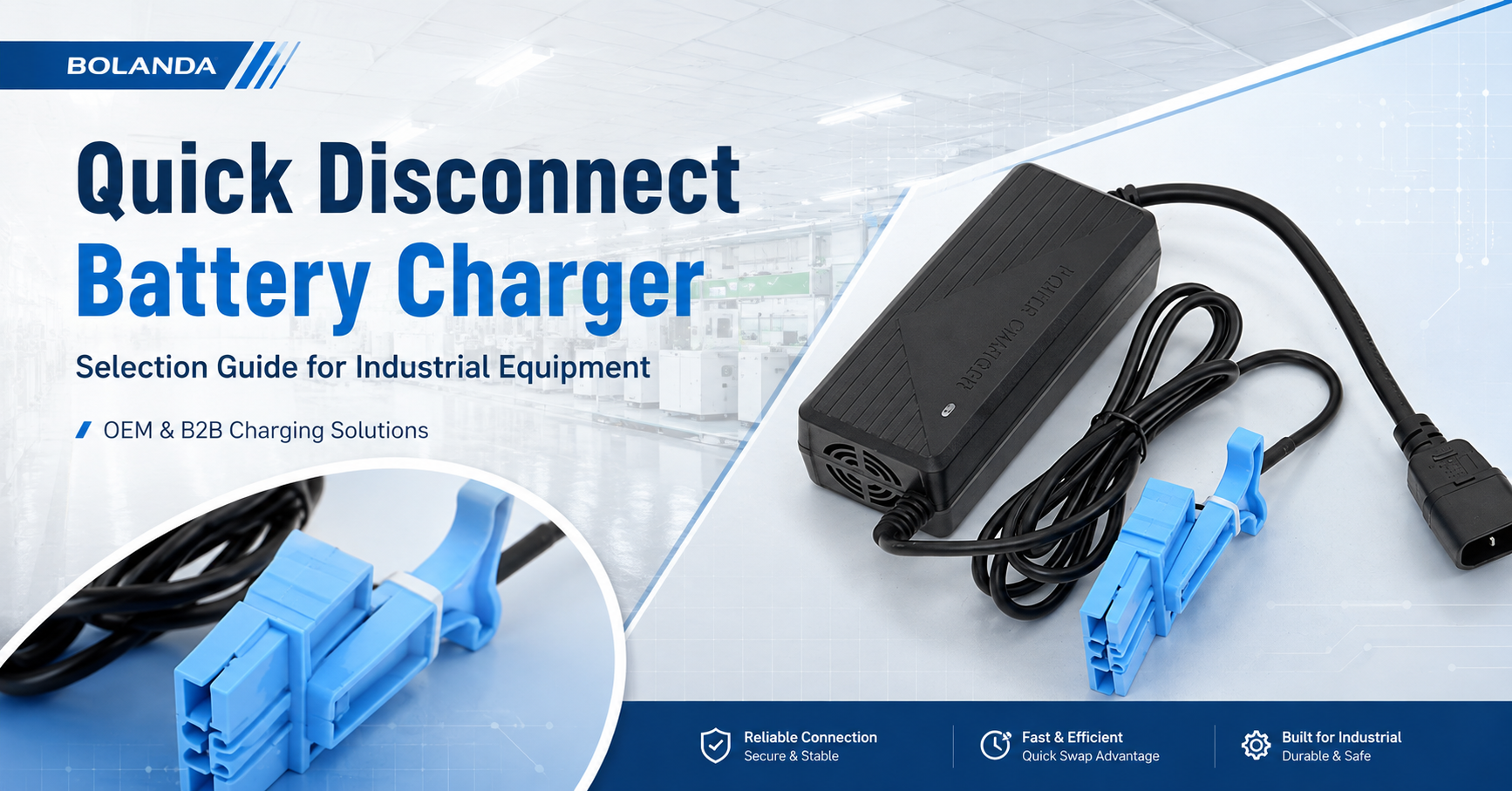
Bolanda's currently published product selection includes compact industrial chargers using red, gray, and blue two-pole connector configurations, including quick-disconnect versions.
A quick-disconnect interface can be useful in applications where batteries or charging equipment are connected and disconnected repeatedly.
However, connector selection involves much more than color.
Buyers should confirm:
- Positive terminal
- Negative terminal
- Current capability
- Mechanical keying
- Contact resistance
- Cable size
- Connector retention
- Connection-cycle durability
- Strain relief
- Polarity protection strategy
A connector that physically fits should never be assumed to be electrically compatible without checking its wiring and ratings.
Two-Pole Connectors vs More Complex Battery Interfaces
Some industrial batteries use a simple two-pole charging interface.
This usually provides:
- Positive connection
- Negative connection
Other battery systems can require additional pins for:
- Temperature sensing
- Battery identification
- Charge permission
- Communication
- Fault signals
The correct interface depends on the battery and equipment platform.
For replacement charger development, provide the supplier with:
- Existing connector
- Connector part number
- Mechanical drawing
- Pinout
- Existing charger sample
This can reduce the chance of developing a charger that fits mechanically but cannot operate correctly.
Cable Design Is Part of Charger Engineering
Industrial charger cables may experience repeated movement, pulling, storage, and connection cycles.
Cable requirements therefore deserve technical attention.
Relevant factors include:
Current Rating
Cable conductors must support the intended charging current.
Length
Longer cable runs can affect voltage drop and handling.
Flexibility
A charger used in a workshop or fleet environment may benefit from a cable construction appropriate for repeated movement.
Strain Relief
Cable entry points should reduce mechanical stress on internal connections.
Connector Termination
The cable-to-connector assembly must remain reliable during repeated use.
Bolanda lists Connector & Cable as one of the OEM/ODM areas that can be reviewed according to the selected product and project requirements.
Evaluate the Operating Environment
Industrial equipment does not always operate in an office-like environment.
Depending on the application, a charger may be exposed to:
- Dust
- High ambient temperature
- Low temperature
- Workshops
- Warehouses
- Equipment vibration
- Frequent handling
- Restricted ventilation
The manufacturer should know where and how the charger will be used.
Important project questions include:
- Is charging indoors or outdoors?
- What ambient-temperature range is expected?
- Is the charger installed permanently or portable?
- Will it sit on a bench, shelf, vehicle, or charging rack?
- Is dust or moisture exposure possible?
- Is natural airflow available?
These conditions can influence enclosure and thermal design.
Thermal Design Becomes More Important as Charging Power Increases
Electrical losses inside the charger become heat.
Potential thermal hotspots include:
- Power semiconductors
- Transformers
- Inductors
- Rectifiers
- PCB assemblies
- Cables
- Connectors
- Housing surfaces
A higher-power charger in a compact enclosure may require significantly more thermal review than a lower-current design.
During sampling, test the charger under representative conditions rather than simply turning it on for a short bench test.
Fast Charging vs Standard Charging
Industrial buyers often want to reduce equipment downtime.
That can create pressure to increase charger current.
However, fast charging introduces tradeoffs.
| Selection Factor | Standard Charging | Higher-Current Charging |
|---|---|---|
| Charge time | Longer | Shorter |
| Charger size | Potentially smaller | May increase |
| Thermal load | Lower | Higher |
| Connector demand | Lower | Higher |
| Cable demand | Lower | Higher |
| Battery stress | Application dependent | Requires closer review |
| Development complexity | Lower | Often greater |
| Best use | Overnight or low-duty charging | Higher equipment utilization |
The right solution depends on operational needs rather than a universal target.
If equipment can charge overnight, the project may prioritize simplicity and thermal margin.
If fleet utilization is high, shorter charging time may justify additional engineering.
Industrial Charger Housing Design
The housing protects the power electronics and influences thermal performance.
For industrial projects, housing evaluation may include:
- Material
- Ventilation
- Mounting
- Mechanical durability
- Cable entry
- Product label
- Installation space
Bolanda's current OEM/ODM framework lists Housing & Label among the configuration areas reviewed for electronic-power projects.
Custom housing does not automatically mean that a completely new enclosure is necessary.
Depending on the project, an existing product platform may offer a faster and lower-risk starting point.
Which Protection Functions Should Buyers Discuss?
Protection requirements vary by charger architecture and application.
Relevant engineering topics may include:
- Output overvoltage behavior
- Output overcurrent
- Short-circuit conditions
- Overtemperature
- Battery abnormal conditions
- Input protection
- Reverse-polarity considerations
- Charge termination
These requirements should be documented rather than assumed.
If a supplier uses phrases such as “multiple protection,” ask exactly which protections are implemented and how each behaves.
Safety and Certification Need to Match the Actual Application
Battery-charger safety requirements depend on the charger design, intended application, electrical ratings, and target market.
IEC 60335-2-29 covers particular safety requirements for certain electric battery chargers within its defined household and similar-use scope. The current consolidated edition specifies scope conditions including output and rated-voltage limits.
Earlier editions also explicitly referenced charger use in locations such as garages, shops, light industry, and farms, but buyers should always confirm which current standard and certification route applies to their exact product.
Do not assume that a certificate for one charger automatically applies to another model or configuration.
Bolanda likewise states that certification availability and scope vary by product model and target market and that only verified certification information is included in formal project documentation.
What Should Be Tested During Industrial Charger Sampling?
A sample should be treated as an engineering-validation stage.
Electrical Verification
Check the approved requirements for:
- Input behavior
- Output voltage
- Charging current
- Charging curve
- Charge termination
- Standby operation
- Fault conditions
Battery Compatibility
Whenever practical, test using the actual battery pack.
For lithium systems, the CC/CV transition and charging-voltage regulation need to match the battery specification.
Thermal Verification
Run representative charging cycles and evaluate:
- Charger housing temperature
- Internal hotspots where applicable
- Connector temperature
- Cable temperature
Mechanical Verification
Check:
- Connector fit
- Cable routing
- Strain relief
- Housing dimensions
- Installation method
- Handling
Appearance Verification
Confirm:
- Product label
- Logo
- Cable
- Connector
- Packaging
- Required accessories
The approved specification and sample should become production references.
How Should Industrial Charger Quality Be Controlled?
“High quality” is not a measurable production requirement.
B2B buyers should look for defined control stages.
Bolanda's published quality approach currently includes four stages: Material Review, Process Inspection, Product Verification, and Release & Delivery.
Material Review
Project-specific components and incoming materials are reviewed before production use.
Process Inspection
Assembly checkpoints are defined around approved production requirements.
Product Verification
Functional and reliability requirements are confirmed for the applicable product and project.
Release and Delivery
Final inspection, packing, and delivery follow the confirmed order and quality plan.
For OEM buyers, the key point is that quality criteria should be tied to a documented charger specification.
Manufacturing Capability Matters for Custom Chargers
An industrial battery charger is a power-electronics product.
The manufacturing process may involve:
- PCB assembly
- SMT components
- Through-hole components
- Cable assembly
- Power components
- Final enclosure assembly
- Functional verification
Bolanda publicly states that its manufacturing services include SMT and through-hole assembly for prototypes and production orders, together with EMS and contract-manufacturing support.
This type of integrated capability can be important when an OEM project requires electrical or assembly changes rather than simply label customization.
OEM and ODM Options for Industrial Battery Chargers
Bolanda states that its customization scope is reviewed according to the selected product, application, target market, and order requirements.
Current published customization areas include:
Input and Output
Electrical requirements can be evaluated according to the project.
Charging Parameters
Battery-specific charging requirements can be reviewed.
Connector and Cable
Connector type and cable requirements can be evaluated, which is particularly relevant to the company's currently published red, gray, and blue two-pole industrial charger models.
Housing and Label
Branding and housing requirements can be reviewed.
Plug Standard
Destination-market AC plug requirements can be considered.
Packaging
OEM packaging requirements can also be evaluated.
Final feasibility needs to be confirmed during project review rather than assumed from a general customization list.
Industrial Battery Charger Selection Checklist
| Area | Question to Answer |
|---|---|
| Battery chemistry | What chemistry is being charged? |
| Nominal voltage | What battery platform is used? |
| Charge voltage | What is the required maximum charging voltage? |
| Battery capacity | How many Ah or Wh? |
| Charge current | What current is permitted and required? |
| BMS | Does the battery have charging limits or communication? |
| Connector | What type, polarity, and current rating? |
| Cable | What length and conductor requirement? |
| Duty cycle | How frequently will the charger operate? |
| Environment | Where will charging take place? |
| Thermal | What ambient temperature is expected? |
| Housing | Portable or fixed installation? |
| Target market | Which country or region? |
| OEM | What branding or customization is required? |
| Quantity | Prototype and volume forecast? |
If these questions can be answered before quotation, supplier evaluation becomes much more accurate.
Common Industrial Charger Procurement Risks
Selecting by nominal voltage only
Risk: Actual charging requirements may not match.
Better approach: Confirm chemistry, cell configuration, charge voltage, current, and BMS.
Copying an existing connector by appearance
Risk: Pinout or current rating may differ.
Better approach: Provide an actual sample or technical drawing.
Choosing the highest possible charging current
Risk: Battery, connector, cable, BMS, or thermal limits may be exceeded.
Better approach: Select current based on the complete charging system.
Ignoring duty cycle
Risk: A charger suitable for occasional use may operate under greater thermal stress in fleet applications.
Better approach: Tell the manufacturer how often and how long the charger will operate.
Assuming certification is universal
Risk: Certification may apply only to a different model or market.
Better approach: Confirm compliance documentation for the exact configuration. Bolanda also states that certification scope is model- and market-specific.
Changing components after sample approval
Risk: Electrical, thermal, reliability, or compliance behavior may change.
Better approach: Use controlled BOM and engineering-change procedures.
What Information Should Be Included in an Industrial Charger RFQ?
A detailed RFQ reduces repeated communication.
| RFQ Item | Information to Provide |
|---|---|
| Application | Equipment type |
| Battery chemistry | Exact chemistry |
| Nominal voltage | Battery platform voltage |
| Maximum charging voltage | Required charger limit |
| Capacity | Ah or Wh |
| Charging current | Target and maximum |
| BMS | Limits and communication |
| Connector | Model, drawing, pinout or sample |
| Input | AC voltage and frequency |
| AC plug | Destination-market requirement |
| Cable | Required length and construction |
| Environment | Temperature and operating conditions |
| Housing | Standard or custom |
| Branding | Logo and label |
| Packaging | OEM or industrial |
| Target market | Country or region |
| Quantity | Prototype and production forecast |
Bolanda's current quotation guidance asks buyers to provide product type, input and output requirements, battery information, connector, expected quantity, and target market.
How to Compare Industrial Battery Charger Suppliers
Use a structured comparison instead of price alone.
| Supplier Evaluation Area | What to Verify |
|---|---|
| Battery expertise | Understands chemistry and charging limits |
| Engineering | Can review electrical requirements |
| Connector support | Can evaluate industrial interfaces |
| Thermal design | Considers duty cycle and environment |
| OEM capability | Supports relevant customization |
| Prototype process | Uses structured sample evaluation |
| Electronics manufacturing | Controls PCB and final assembly |
| Quality control | Has defined inspection stages |
| Reliability | Evaluates application risks |
| Certification | Confirms exact model and market scope |
| Supply chain | Controls components and alternatives |
| Documentation | Maintains approved specifications |
| Communication | Technical issues are clearly explained |
| Commercial planning | MOQ and timing reflect the actual project |
For industrial equipment, a supplier that prevents compatibility problems before production can create more value than one offering the lowest initial quotation.
Frequently Asked Questions About Industrial Battery Chargers
What is an industrial battery charger?
An industrial battery charger is designed to charge batteries used in commercial or industrial equipment and is selected according to the battery chemistry, voltage, current, BMS, connector, duty cycle, environment, and equipment requirements.
Can I use any charger with the same voltage?
No. Nominal voltage alone does not confirm compatibility. Maximum charging voltage, chemistry, current, BMS requirements, and connector configuration should also match.
What is CC/CV charging?
CC/CV means constant-current and constant-voltage charging. It is commonly used for lithium-ion systems, with controlled current during the initial phase followed by regulated voltage as the battery approaches full charge.
How do I choose charging current?
Use the battery manufacturer's permitted charge-current range and also consider BMS, connector, cable, thermal conditions, duty cycle, and required charging time.
What is a quick-disconnect battery charger connector?
It is a connector designed to allow convenient repeated connection and disconnection between the charger and battery system. Exact electrical ratings, polarity, and mechanical design must still be verified. Bolanda currently publishes industrial charger models using red and blue two-pole quick-disconnect connectors.
Can industrial charger connectors be customized?
Connector and cable requirements can be evaluated for OEM projects. Bolanda currently lists connector and cable configuration among its OEM/ODM project options.
Can voltage and charging current be customized?
Bolanda currently includes input/output and charging parameters in its project-review scope, but final feasibility depends on the selected product, battery, application, and engineering requirements.
Can the charger use my company logo?
Housing and label requirements are included within Bolanda's current OEM/ODM configuration framework, subject to project review.
What is the MOQ for an industrial charger?
Bolanda does not publish one universal MOQ. Its website states that MOQ varies by product model and customization requirements and is evaluated for each project.
What should I provide before requesting a quotation?
Provide battery specifications, charging voltage and current, BMS information, connector, equipment application, operating environment, target market, customization requirements, and expected quantity.