What Is an Electronic Power Product Manufacturer?
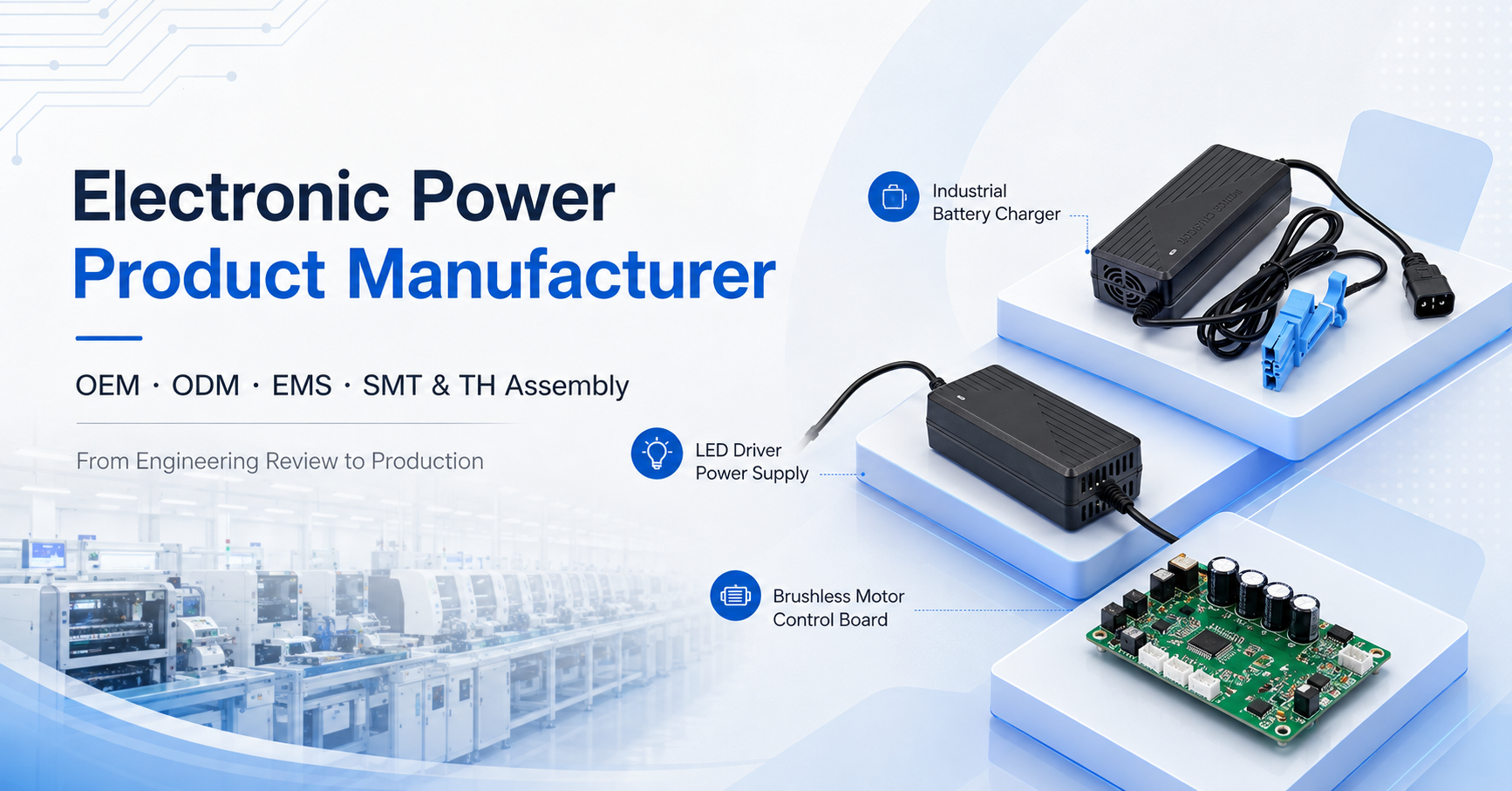
An electronic power product manufacturer develops or manufactures electronic products that convert, regulate, distribute, charge, or control electrical power for a defined application.
Depending on the company and project scope, these products can include:
- Battery chargers
- LED driver power supplies
- Motor control boards
- Power-control PCBs
- Charging electronics
- Application-specific electronic power assemblies
Bolanda currently identifies five core electronic-power product lines: Power Tool Chargers, LED Driver Power Supplies, Brushless Motor Control Boards, Logistics Lithium Equipment Chargers, and E-Bike & Motorcycle Chargers. The company also describes itself as an integrated electronics manufacturing provider focused on electronic power products.
For an OEM buyer, however, product range is only the first screening criterion.
The more important question is whether the manufacturer can convert your application requirements into a controlled product and production process.
Why Electronic Power Manufacturing Requires More Than PCB Assembly
A finished electronic power product can combine several technical and manufacturing elements:
- PCB design or adaptation
- Power semiconductor selection
- Control ICs
- Magnetic components
- Capacitors
- SMT components
- Through-hole components
- Firmware or control logic
- Connectors
- Cables
- Enclosures
- Thermal management
- Functional testing
This makes electronic power manufacturing different from simply purchasing a bare PCB.
The buyer needs to know who is responsible for:
engineering → components → assembly → validation → final product → production control
Bolanda's public manufacturing scope includes EMS and contract manufacturing, OEM/ODM development, SMT and through-hole assembly, prototype and reliability verification, and material/component support.
Start With the Application, Not the Factory Catalog
A common sourcing mistake is searching for a manufacturer before clearly defining the application.
For example, asking for:
“a lithium battery charger”
does not tell the manufacturer enough to define the project.
Likewise:
“an LED driver”
or:
“a brushless motor controller”
is only a product category.
A stronger project brief starts with actual operating requirements.
| Project Area | Information to Define |
|---|---|
| Application | What will the electronic product control or power? |
| Input | Required electrical input |
| Output | Required voltage, current or control output |
| Load | Battery, LED, motor or other equipment |
| Control | Charging logic, dimming, motor control or communication |
| Environment | Temperature and operating conditions |
| Mechanical | Housing, PCB and connector constraints |
| Target market | Destination countries or regions |
| Volume | Prototype and expected production quantity |
| Customization | Electrical, mechanical, branding or packaging |
Bolanda currently asks project customers to provide electrical specifications, application, connector, target market, and order quantity for project review.
This information gives engineering and commercial teams a clearer basis for feasibility evaluation.
Evaluate Engineering Capability Before Manufacturing Capacity
Production capacity matters only after the product definition is technically correct.
For OEM power-electronics projects, buyers should first determine whether the supplier can understand the technical requirements.
A manufacturer should be able to discuss topics such as:
- Input conditions
- Output conditions
- Load behavior
- Current limits
- Protection strategy
- Thermal conditions
- PCB requirements
- Connector requirements
- Control logic
- Validation requirements
The exact technical questions depend on the product.
For example, a battery charger requires different engineering knowledge from an LED driver or BLDC control board.
A manufacturer does not need to redesign every project from zero, but it should be able to identify whether an existing platform can be adapted and where additional development is required.
Existing Platform vs New Product Development
Not every OEM project needs a completely new design.
There are generally three practical routes.
Existing Product With Branding Changes
This may involve:
- Logo
- Label
- Packaging
- Cable
- Plug
This route usually has the lowest technical-change burden.
Existing Platform With Engineering Changes
This may involve:
- Input/output changes
- Connector changes
- Charging parameters
- Cable configuration
- Housing requirements
- Control-function changes
Bolanda currently lists input/output, charging parameters, connector and cable, housing and label, plug standard, and packaging among the areas evaluated within its OEM/ODM framework.
New or More Extensive Development
Some projects may require substantial electrical, mechanical, hardware, or software work.
In these cases, the buyer should expect a more detailed feasibility review, prototype process, validation program, and commercial evaluation.
Why SMT Capability Matters
Surface-mount technology allows electronic components to be mounted onto printed circuit boards and is fundamental to modern electronics assembly.
For power-electronics buyers, the important question is not simply whether the factory owns an SMT line.
Ask whether its manufacturing process can support:
- Prototype assembly
- Volume production
- Component identification
- Placement control
- Soldering process control
- Inspection
- Rework procedures
- Traceability requirements
Bolanda states that it provides surface-mount assembly for both prototypes and production orders.
This can be useful for OEM programs because prototype assembly and later volume production can be managed within one manufacturing framework.
Why Through-Hole Assembly Still Matters in Power Electronics
Electronic power products frequently contain components that are not exclusively surface mounted.
Depending on the design, these may include:
- Large capacitors
- Connectors
- Transformers
- Inductors
- Relays
- Power terminals
- Mechanical components
Through-hole assembly can therefore remain relevant in charger, driver, and control-board manufacturing.
Bolanda publicly lists both SMT and through-hole assembly within its current manufacturing capabilities.
For buyers, this means the supplier evaluation should consider the complete PCB assembly, not only SMT capability.
Use Recognized Electronics Assembly Standards as a Quality Reference
When an OEM project requires defined electronics workmanship criteria, buyers and manufacturers can use recognized industry standards to establish a common language.
IPC-A-610 defines acceptance requirements for electronic assemblies, while IPC J-STD-001 addresses requirements for soldered electrical and electronic assemblies. IPC states that the two standards can be used together for electronics manufacturing and inspection.
This does not mean every supplier automatically manufactures to a specific IPC class.
For an OEM buyer, the useful sourcing question is:
What workmanship and acceptance criteria are agreed for this project?
If IPC requirements are necessary, they should be specified in procurement documentation and confirmed with the manufacturer.
IPC Classes Should Not Be Assumed
Electronics projects can have different reliability expectations.
A low-cost consumer device and a high-reliability industrial control product may not require exactly the same acceptance level.
IPC's manufacturing-validation program recognizes different electronic assembly classes and uses J-STD-001 together with IPC-A-610 for qualified manufacturing processes.
The buyer should therefore define required workmanship standards based on the actual product rather than requesting the “highest class” without understanding the commercial and technical implications.
Component Selection Can Determine Product Reliability
Power-electronics performance depends heavily on the bill of materials.
Critical component categories can include:
- MOSFETs
- Diodes
- Control ICs
- Capacitors
- Transformers
- Inductors
- Resistors
- Connectors
- Cable
- PCB materials
A supplier evaluation should therefore ask more than:
“Which brand components do you use?”
More useful questions include:
- Is there an approved BOM?
- Which components are critical?
- Are approved manufacturers defined?
- How are alternatives evaluated?
- Can substitutions occur without customer approval?
- What happens when a component becomes obsolete?
Bolanda publicly lists material coordination and component-alternative support as part of its supply-chain capability.
For long-running OEM programs, this can help reduce disruption when parts become unavailable.
BOM Control Is Especially Important After Sample Approval
An approved sample is only meaningful if production remains consistent with the approved configuration.
Imagine that an OEM buyer approves a charger after:
- Electrical testing
- Thermal testing
- Battery compatibility testing
If a critical component is later replaced without adequate review, the product may behave differently.
Potentially affected characteristics can include:
- Efficiency
- Temperature
- Output regulation
- Protection behavior
- Reliability
- Compliance
A professional OEM project therefore needs change control.
Important component substitutions should be technically reviewed and documented before implementation.
Evaluate Supply Chain Capability, Not Only Purchasing Price
Power-electronics manufacturing can depend on many electronic components sourced from multiple suppliers.
Component shortages, end-of-life notices, or long lead times can affect production.
Ask the manufacturer:
- How are long-lead components identified?
- Are alternative components planned?
- How are shortages communicated?
- Who approves substitutions?
- Are critical components purchased from controlled channels?
- How is material traceability handled where required?
Bolanda describes its supply-chain support as including material coordination and component alternatives for project continuity.
This type of capability becomes increasingly important as the expected project lifecycle increases.
Prototype Validation Should Happen Before Volume Production
A prototype should not be viewed simply as a sales sample.
For electronic power projects, sampling provides an opportunity to identify:
- Electrical mismatches
- Thermal problems
- Connector issues
- Control problems
- Mechanical conflicts
- Component issues
- Application incompatibility
Bolanda's published project process places Sample Evaluation before Project Approval and Production, while its manufacturing overview states that prototype and reliability checks are intended to identify risks before volume production.
That sequence is useful for B2B projects because technical approval should occur before mass-production release.
What Should Be Validated During Sampling?
The exact test program depends on the product.
A useful framework includes several categories.
Electrical Verification
Depending on the product:
- Input behavior
- Output voltage
- Output current
- Control behavior
- Power
- Startup
- Shutdown
- Protection
Functional Verification
Confirm that the product performs correctly with the actual equipment.
Examples include:
- Charger with battery
- LED driver with LED module
- Motor controller with motor and load
Thermal Verification
Evaluate the product at representative:
- Load
- Ambient temperature
- Enclosure condition
- Operating duration
Mechanical Verification
Check:
- PCB dimensions
- Housing
- Connectors
- Cable routing
- Mounting
- Assembly
Appearance and Packaging
For private-label projects:
- Logo
- Label
- Product identification
- Packaging
- Accessories
Reliability Verification Should Follow the Application
Reliability testing should not be treated as a generic checklist copied from unrelated products.
A charger, LED driver, and motor-control board face different operating conditions.
Possible project-specific evaluations can include:
- Extended full-load operation
- Temperature testing
- Repeated startup
- Charging cycles
- Motor operating cycles
- Connector cycles
- Cable durability
- Fault conditions
Bolanda states that functional and reliability verification requirements are confirmed for the applicable product and project rather than presented as one universal test package.
This project-specific approach is appropriate because meaningful validation should reproduce actual operating risks.
Quality Control Should Be Defined by Stage
A buyer should be cautious when a manufacturer only says:
“We have strict QC.”
A stronger answer explains when and how the product is controlled.
Bolanda currently publishes four major stages in its quality approach.
Material Review
Incoming materials and project-specific components are reviewed before production use.
Process Inspection
Assembly and production checkpoints are organized around approved manufacturing requirements.
Product Verification
Functional and reliability verification is defined for the relevant product and project.
Release and Delivery
Final inspection, packaging, and delivery follow the confirmed order and quality plan.
For an OEM buyer, this gives a better basis for quality discussion than broad promotional claims.
Incoming Inspection Is Particularly Important for Critical Components
A finished electronic product cannot be more consistent than the components entering production.
Incoming inspection may need to verify items such as:
- Part number
- Supplier
- Specification
- Appearance
- Quantity
- Packaging
- Project-specific electrical requirements
The exact inspection depth should be based on component criticality and project risk.
This is why quality planning should begin with the BOM rather than only at final inspection.
Process Inspection Finds Problems Earlier
Waiting until final testing to discover assembly defects can increase rework and delay production.
Process inspection may cover areas such as:
- Component placement
- Polarity
- Soldering
- Through-hole installation
- Connector assembly
- Cable assembly
- Mechanical construction
IPC-A-610 provides established electronic-assembly acceptance criteria covering component mounting, soldering conditions, component damage, laminate conditions, cleaning, and related assembly characteristics.
If such standards are required for a project, the exact revision and acceptance requirements should be agreed in advance.
Product Verification Should Follow the Approved Specification
Final testing should answer one simple question:
Does the manufactured unit meet the approved project requirements?
The test plan may include:
- Electrical parameters
- Functional performance
- Control functions
- Charging behavior
- Protection functions
- Output stability
It should not depend on an operator's subjective opinion that the product “works.”
Documented limits make supplier and buyer expectations clearer.
Traceability Becomes More Important as Project Risk Increases
Not every commercial product requires the same traceability depth.
However, long-running B2B projects may benefit from the ability to identify:
- Production batch
- Material batch
- BOM revision
- PCB revision
- Firmware version
- Test status
This can make root-cause analysis easier if a problem appears after production.
Traceability requirements should be agreed according to the actual project rather than assumed.
Hardware and Software Capability Can Matter
Modern electronic power products increasingly combine power circuitry with embedded control.
Depending on the application, software or firmware can influence:
- Charging logic
- Communication
- Protection behavior
- Status indication
- Motor control
- Product configuration
Bolanda currently describes its ODM/OEM offering as including customized hardware and software support for electronic-power projects.
For buyers developing more advanced control products, software ownership, revision control, validation, and change-management responsibilities should be defined early.
Ask Who Owns the Technical Documentation
A mature OEM project should have controlled documents.
Depending on scope, these may include:
- Product specification
- BOM
- PCB revision
- Schematics
- Connector drawing
- Cable drawing
- Firmware revision
- Test specification
- Packaging specification
The buyer should clarify:
- Which documents are customer-owned?
- Which are manufacturer-owned?
- Which changes require approval?
- Who maintains revisions?
Clear documentation reduces misunderstandings when the project moves from engineering into production.
Electronic Power OEM vs ODM: What Is the Difference?
The exact terminology varies across suppliers, but a practical distinction can be useful.
| Project Type | Typical Starting Point |
|---|---|
| Standard product | Existing product with little or no change |
| OEM | Existing or customer-defined product customized for buyer requirements |
| ODM | Manufacturer contributes more product design or development |
| EMS/CM | Manufacturer builds according to defined customer manufacturing requirements |
Real projects can overlap these categories.
The more important question is not what label the supplier uses.
Ask:
Who is responsible for design, engineering changes, component selection, testing, and manufacturing?
Bolanda currently offers both OEM/ODM support and EMS/CM manufacturing services.
What Products Can an Integrated Electronic Power Manufacturer Support?
An integrated manufacturer can support different products through common electronics-manufacturing capabilities.
Bolanda's current portfolio illustrates several application categories.
Power Tool Chargers
Charging electronics for power-tool battery applications.
LED Driver Power Supplies
Power conversion for LED lighting applications.
Brushless Motor Control Boards
Electronic control boards for brushless-motor projects.
Logistics Lithium Equipment Chargers
Charging systems for logistics and material-handling equipment.
E-Bike and Motorcycle Chargers
Charging products for electric mobility applications.
These products have different electrical requirements but share manufacturing needs such as PCB assembly, components, testing, quality control, and supply-chain management.
Electronic Power Manufacturer Evaluation Checklist
| Evaluation Area | What to Verify |
|---|---|
| Product experience | Relevant electronic power applications |
| Engineering | Can review electrical and application requirements |
| Hardware | Can support PCB/product engineering where required |
| Software | Can support control logic where applicable |
| SMT | Controlled surface-mount assembly |
| Through-hole | Capability for power and mechanical components |
| Components | Approved BOM and sourcing control |
| Prototypes | Structured sample process |
| Testing | Defined functional test requirements |
| Reliability | Application-specific verification |
| Quality | Incoming, process and final control |
| Standards | Can support agreed workmanship requirements |
| Documentation | Revision and specification control |
| Supply chain | Component continuity and alternatives |
| Change control | Customer review of important changes |
| OEM/ODM | Required customization scope |
| Production | Can transfer prototype into stable volume production |
This type of checklist is more useful than comparing factory size alone.
Common Sourcing Risks
Selecting a supplier based only on low price
Risk: Engineering, testing, component quality, or change-control requirements may be excluded.
Better approach: Compare the complete manufacturing scope.
Assuming SMT capability equals complete manufacturing capability
Risk: Power products may also require through-hole assembly, cable integration, final assembly, and testing.
Better approach: Evaluate the complete production route.
Approving a sample without an approved specification
Risk: The manufacturer may not know which parameters must remain unchanged.
Better approach: Freeze key electrical, mechanical, component, and test requirements before production.
Allowing uncontrolled BOM substitutions
Risk: Product performance or reliability can change.
Better approach: Establish component-change approval rules.
Using generic quality claims
Risk: Buyer and supplier may interpret “high quality” differently.
Better approach: Define inspection and acceptance criteria.
Asking for certifications without identifying the product
Risk: Certification scope may apply to a different model.
Better approach: Confirm compliance requirements against the exact product configuration. Bolanda itself states that certification availability and scope vary by product and target market.
What Information Should Be Included in an RFQ?
| RFQ Item | Information to Provide |
|---|---|
| Product | Charger, LED driver, control board or other |
| Application | End equipment |
| Input | Electrical input requirements |
| Output | Voltage, current, power or control requirements |
| Load | Battery, LED, motor or other |
| Control | Required logic or communication |
| Environment | Temperature and use conditions |
| PCB | Existing design or development requirement |
| Connector | Model, drawing or sample |
| Housing | Mechanical requirements |
| Software | Firmware requirements if applicable |
| Quality | Inspection or workmanship requirements |
| Target market | Destination country/region |
| Forecast | Prototype and production quantity |
| OEM requirements | Branding, cable, label, packaging, etc. |
Bolanda recommends providing electrical specifications, application, connector, target market, and order quantity when submitting a project for review.
The more complete the RFQ, the easier it becomes to compare manufacturers on the same technical basis.
Frequently Asked Questions About Electronic Power Product Manufacturers
What does an electronic power product manufacturer make?
It can manufacture products that convert, regulate, charge, distribute, or control electrical power, such as battery chargers, LED drivers, power-control boards, and motor-control electronics. Bolanda's current portfolio includes these types of charger, driver, and control-board categories.
What should I evaluate before choosing a power electronics manufacturer?
Evaluate engineering capability, SMT and through-hole assembly, component sourcing, BOM control, prototype validation, functional testing, reliability verification, quality control, documentation, OEM/ODM capability, and supply-chain management.
What is the difference between OEM, ODM and EMS?
The terms can overlap, but OEM generally focuses on manufacturing/customization for a buyer, ODM can involve more manufacturer-led development, while EMS/CM focuses on manufacturing services around defined product requirements. The exact responsibility split should be confirmed for each project.
Why are SMT and through-hole capabilities both useful?
Modern PCB assemblies use many surface-mount components, while electronic power products can also contain larger connectors, capacitors, transformers, terminals, or other through-hole components. Bolanda currently lists both SMT and TH assembly.
What is IPC-A-610?
IPC-A-610 is an electronics assembly acceptance standard covering acceptance requirements for electronic assemblies.
What is IPC J-STD-001?
IPC J-STD-001 provides requirements for soldered electrical and electronic assemblies and is widely used as an industry reference for soldering processes and materials.
Does every manufacturer need the same IPC class?
No. Required workmanship and acceptance criteria depend on the product and buyer requirements. If a specific IPC class or standard is required, it should be defined in the project documentation rather than assumed.
Can electronic power products be customized?
Customization depends on the manufacturer and platform. Bolanda currently reviews input/output, charging parameters, connectors and cables, housing and labels, plug standards, and packaging according to project requirements.
How should prototypes be approved?
Use defined electrical, functional, thermal, mechanical, and appearance criteria. Bolanda's published workflow places sample evaluation before project approval and production.
Does Bolanda support electronic power OEM projects?
Yes. Bolanda currently positions itself as an OEM/ODM electronic power manufacturer and provides EMS/CM, hardware/software support, SMT and through-hole assembly, reliability verification, and supply-chain coordination for B2B projects.