What Is an E-Bike Battery Charger?
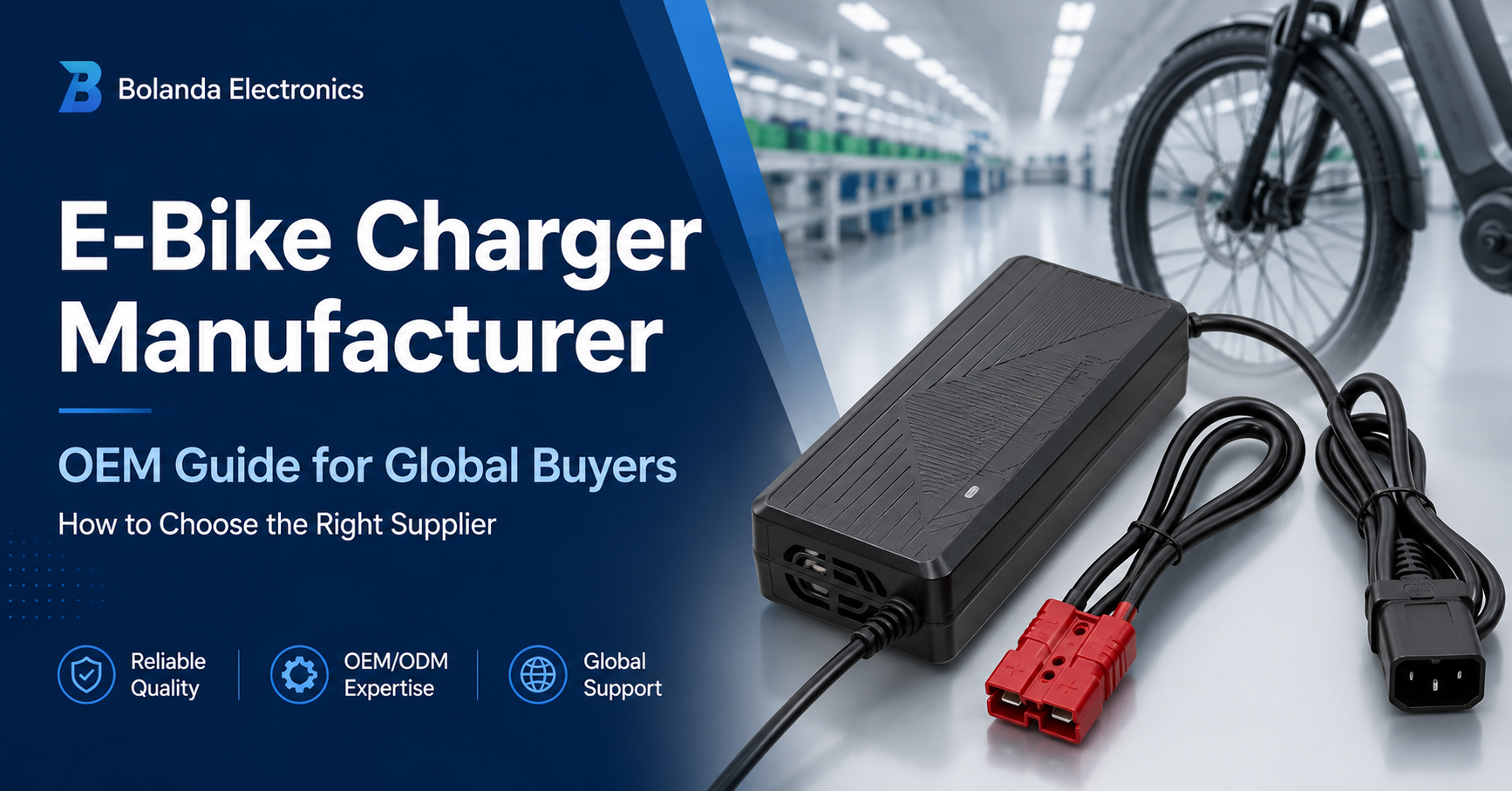
An e-bike battery charger is an electronic power device designed to charge the rechargeable battery pack used in an electric bicycle.
Although the concept appears simple, an e-bike charger is part of a larger electrical system that includes the battery cells, battery management system, connector, cabling, vehicle electronics, and charging interface.
For this reason, charger compatibility cannot be determined by connector shape or nominal battery voltage alone.
Bosch eBike Systems specifically advises that the charger must match the battery and states that its battery management system monitors battery operation and detects conditions such as excessive temperature, overload, and deep discharge.
For an OEM project, the safest starting point is therefore the battery specification.
Which Buyers Need an OEM E-Bike Charger?
A standard replacement charger may be sufficient when the bicycle uses an established battery platform with a defined charging interface.
OEM or customized chargers become more relevant for:
• E-bike manufacturers developing new models
• Electric bicycle battery-pack suppliers
• Private-label e-bike brands
• Electric mobility distributors
• Replacement charger programs
• Shared bicycle or fleet projects
• Electric motorcycle projects
• Regional product versions requiring different AC plugs
• Battery platforms with proprietary connectors
• Projects requiring custom labels or packaging
Bolanda currently lists E-Bike & Motorcycle Chargers as one of its five confirmed electronic power product categories. Its OEM/ODM scope includes project review of input/output requirements, charging parameters, connectors and cables, housing and labels, plug standards, and packaging.
Start With the E-Bike Battery Specification
Before asking a supplier for an electric bike charger, prepare the information that defines the charging requirements.
| Battery Information | Why It Matters |
|---|---|
| Battery chemistry | Determines the appropriate charging profile |
| Cell configuration | Helps establish charging voltage |
| Nominal voltage | Identifies the battery platform |
| Maximum charging voltage | Defines an important charger output limit |
| Battery capacity | Influences charging-current selection |
| Maximum charge current | Establishes the battery-side current limit |
| BMS specification | May define protection and communication requirements |
| Temperature sensing | Can influence charging permission |
| Connector pinout | Determines electrical compatibility |
| Battery enclosure | Affects mechanical charging interface |
| Intended bicycle | Helps define use conditions |
An RFQ that only says “I need a 48V e-bike charger” is often incomplete.
The supplier may still need to know the battery chemistry, series configuration, full-charge voltage, charging-current limit, BMS requirements, connector, and destination market.
Why Nominal Battery Voltage Is Not Enough
Nominal battery voltage is commonly used to describe an e-bike platform.
However, it should not automatically be treated as the required charger output voltage.
The charger must follow the battery's actual charging specification.
For a professional sourcing project, buyers should provide:
• Nominal battery voltage
• Maximum charging voltage
• Cell configuration
• Battery chemistry
• BMS charging limits
• Existing approved charger specification, if available
This reduces the risk of selecting a charger solely because the product label appears to match the battery.
How Lithium-Ion E-Bike Charging Works
Many modern e-bike batteries use lithium-ion cells.
Lithium-ion charging commonly follows a constant-current/constant-voltage, or CC/CV, charging profile.
During the constant-current stage, the charger regulates charging current while battery voltage rises.
When the defined voltage limit is reached, the charger enters constant-voltage regulation and current gradually decreases.
Texas Instruments describes CC/CV as the standard charging profile used in its lithium-ion charging references.
For B2B buyers, this means charger voltage and charging current should always be evaluated together with the battery specification.
How to Select E-Bike Charger Current
Charging current influences:
• Charging time
• Charger power
• Battery temperature
• Charger temperature
• Cable requirements
• Connector current rating
• Component selection
• Housing and thermal design
Higher charging current can shorten charging time, but it does not automatically mean a better charger.
The maximum appropriate value should be determined from:
Battery cell limits
The cell manufacturer's charging specification provides an important operating boundary.
Battery BMS limits
The BMS may impose its own maximum charging-current conditions.
Connector and cable limits
Electrical interfaces need sufficient current capability.
Thermal conditions
Higher power can increase heat inside the charger, cables, connector, and battery.
Product positioning
A compact travel charger and a faster home or workshop charger may have different design priorities. Bosch, for example, offers several charger formats for different e-bike use cases, demonstrating that charger size, charging rate, and portability involve product-level tradeoffs.
Therefore, charging current should be chosen around the complete application rather than from a single “fast charging” target.
Charging Time Should Not Be Estimated From Capacity Alone
A common calculation is:
Battery capacity ÷ charger current = charging time
This can provide a rough planning estimate, but it should not be treated as exact.
In lithium-ion charging, current decreases during the constant-voltage phase as the battery approaches full charge.
Actual charging time can also be affected by:
• Initial battery state of charge
• Battery temperature
• Battery capacity
• Charging-current limit
• BMS behavior
• Charge termination logic
• Constant-voltage phase duration
Therefore, a charger should be tested with the actual battery pack before charging-time claims are finalized.
Why BMS Compatibility Matters
The battery management system is an important part of an e-bike battery pack.
Depending on the battery architecture, the BMS can monitor or control:
• Battery voltage
• Cell conditions
• Temperature
• Charging current
• Overcharge conditions
• Deep discharge
• Fault conditions
• Communication
Bosch describes its e-bike BMS as monitoring the battery and detecting potential fault conditions.
However, the presence of a BMS does not mean any charger with the same voltage can be connected to the battery.
The charger still needs to match the charging parameters and interface expected by the battery system.
Check Whether Communication Is Required
Some battery systems use a simple positive and negative charging connection.
Others may include additional contacts for:
• Temperature sensing
• Battery identification
• Charge enable
• Communication
• Status information
If communication is required, the charger manufacturer may need:
• Interface specification
• Protocol documentation
• Battery sample
• Existing charger sample
• Connector drawing
• Pinout definition
Communication requirements should be identified before prototype development.
E-Bike Charger Connector Selection
Connector compatibility involves both electrical compatibility and mechanical compatibility.
A connector that physically fits the battery may still have an incorrect pin arrangement.
Before approving an OEM charger, confirm:
Polarity
Positive and negative terminals must be clearly defined.
Signal pins
Determine whether additional contacts are used.
Current capability
The connector should be suitable for the intended charging current.
Mechanical retention
The connector should remain secure during normal use.
Connection durability
Repeated charging can create many insertion and removal cycles over the life of the bicycle.
Cable strain relief
Cable movement should not create excessive stress at the connector or charger housing.
For an OEM project, sending a connector drawing or physical sample is more reliable than providing only a photograph.
AC Plug Selection for Different Markets
The battery-side connector is only one side of the charger.
The AC input configuration must also match the destination market.
Projects may need different:
• Plug types
• Input voltage ranges
• Cable configurations
• Labels
• User documentation
• Packaging
Bolanda currently includes plug standard among the OEM/ODM configuration areas reviewed for electronic power projects.
Defining the target country at the RFQ stage can prevent unnecessary redesign later.
Thermal Design Is Important for E-Bike Chargers
Charging electronics generate heat.
Thermal behavior becomes more important when:
• Charging power increases
• Charger size decreases
• Ambient temperature increases
• Ventilation is limited
• Charging cycles are long
• The charger is used frequently
Possible thermal hotspots include:
• Switching devices
• Transformers and magnetic components
• Rectifiers
• PCB assemblies
• Connectors
• Cables
• Enclosures
Prototype testing should therefore include realistic charging cycles rather than only brief bench operation.
Portable Charger vs Higher-Power Charger
Different e-bike applications can require different charger priorities.
| Requirement | Portable Charger | Higher-Power Charger |
|---|---|---|
| Size | Smaller priority | May be larger |
| Weight | Important | Less critical |
| Charging speed | Moderate | Higher priority |
| Thermal challenge | Moderate | Generally greater |
| Portability | Strong | Application dependent |
| Typical use | Travel or backup | Home, workshop or faster charging |
| Cable requirements | Application dependent | May require higher current capability |
There is no universal “best” configuration.
The correct solution depends on the battery, target charging time, mobility requirements, product positioning, and operating environment.
What Protection Requirements Should Buyers Discuss?
The exact protection architecture depends on the charger and battery design.
Potential areas for engineering review include:
• Output overvoltage behavior
• Output overcurrent behavior
• Short-circuit protection
• Overtemperature protection
• Battery abnormal conditions
• Reverse connection considerations
• Input protection
• Charging termination
• Fault recovery
The important sourcing principle is not to assume every charger includes identical protection functions.
Protection requirements should be included in the approved technical specification.
What Should Be Tested During E-Bike Charger Sampling?
Sample approval should be treated as a technical validation stage.
Electrical Testing
Verify:
• Input operation
• Output voltage
• Charging current
• Charging curve
• Charge termination
• Standby behavior
• Battery detection
Battery Compatibility Testing
Use the actual target battery pack whenever practical.
Bosch emphasizes the importance of using a charger compatible with the relevant e-bike battery system.
For OEM projects, compatibility testing should therefore be completed before volume production.
Thermal Testing
Evaluate the charger throughout representative charging cycles.
Measure or inspect relevant temperatures around:
• Charger enclosure
• Power electronics
• Cable
• Connector
• Battery interface
Mechanical Testing
Check:
• Connector fit
• Insertion and removal
• Cable routing
• Strain relief
• Housing integrity
• AC plug
Appearance Approval
Confirm:
• Logo
• Label
• Product information
• Housing finish
• Packaging
• Accessories
• Manuals where applicable
E-Bike Charger OEM Customization Options
For many projects, customization does not require designing an entirely new charger from zero.
An existing charger platform may be adapted where technically feasible.
Bolanda currently describes its customization scope around six major areas.
Input and Output
Electrical parameters can be evaluated according to the battery and application.
Charging Parameters
Charging requirements can be reviewed around the confirmed battery specification.
Connector and Cable
Battery connectors and cable requirements can be evaluated for project compatibility.
Housing and Label
Private-label and product-identification requirements can be reviewed.
Plug Standard
The AC plug can be selected according to the target market where supported.
Packaging
OEM and project-specific packaging can be evaluated according to order requirements.
Final feasibility remains dependent on the selected product platform and confirmed project requirements.
How to Evaluate an E-Bike Charger Supplier
Price alone does not provide enough information for an OEM decision.
Use a structured comparison.
| Evaluation Area | What the Buyer Should Verify |
|---|---|
| Battery understanding | Can the supplier interpret battery specifications? |
| Electrical engineering | Can voltage and current requirements be reviewed? |
| BMS knowledge | Can interface requirements be understood? |
| Connector support | Can electrical and mechanical fit be evaluated? |
| OEM customization | Are relevant parameters customizable? |
| Sample validation | Is there a structured prototype process? |
| Thermal evaluation | Are operating conditions considered? |
| Manufacturing | Can production follow the approved specification? |
| Quality control | Are defined checkpoints used? |
| Reliability | Are application risks evaluated? |
| Certification planning | Is the target market considered? |
| Supply chain | Are components and alternatives controlled? |
| Communication | Are technical issues explained clearly? |
A supplier that identifies technical uncertainties early can reduce risk later in the project.
Common E-Bike Charger Procurement Risks
Choosing a charger by voltage label alone
Risk: Nominal battery voltage may not provide the full charging specification.
Better approach: Confirm chemistry, series configuration, maximum charge voltage, BMS, and current requirements.
Assuming the connector guarantees compatibility
Risk: Pinout or signaling may be different.
Better approach: Supply the connector drawing, pin definition, and sample where possible.
Requesting maximum charging current without thermal review
Risk: Battery, connector, cable, or charger temperature may become unacceptable.
Better approach: Determine current from battery limits and realistic testing.
Ignoring the destination market until production
Risk: Plug, labeling, documentation, or certification requirements may require changes.
Better approach: Define the target market during the initial RFQ.
Approving only the visual sample
Risk: A charger can look correct while electrical or charging behavior remains unsuitable.
Better approach: Use a documented technical sample-approval process.
What Information Should Be Included in an E-Bike Charger RFQ?
| RFQ Requirement | Information to Provide |
|---|---|
| Bicycle application | E-bike type and use case |
| Battery chemistry | Exact chemistry |
| Nominal voltage | Battery system voltage |
| Maximum charge voltage | Required charger output limit |
| Capacity | Ah or Wh |
| Charging current | Target and maximum |
| BMS | Charging and interface requirements |
| Connector | Drawing, pinout, photo or sample |
| Input power | Required AC input |
| AC plug | Destination-country type |
| Cable | Length and configuration |
| Housing | Standard or customized |
| Branding | Logo and label |
| Packaging | OEM or retail |
| Target market | Destination country or region |
| Quantity | Sample and production forecast |
Bolanda's published quotation guidance asks buyers to provide product type, input and output requirements, battery information, connector, estimated quantity, and target market.
A detailed RFQ allows technical feasibility and commercial terms to be evaluated more accurately.
Frequently Asked Questions About E-Bike Battery Chargers
What charger do I need for my e-bike battery?
Use a charger specifically compatible with the battery chemistry, cell configuration, maximum charging voltage, BMS, connector, and permitted charging current. Nominal battery voltage alone is not sufficient.
Can I use any charger with the same voltage?
Not necessarily. Battery interface, BMS requirements, actual charge voltage, current, connector pinout, and charging logic may differ. Bosch likewise advises using chargers compatible with the battery system.
Does a higher-amp e-bike charger charge faster?
Higher charging current can reduce charging time, but only when the battery, BMS, connector, cable, thermal system, and charger are designed to support it.
What is CC/CV charging?
CC/CV means constant-current/constant-voltage charging. It is a widely used charging profile for lithium-ion batteries, with current regulated initially and voltage controlled as the battery approaches its final charging level.
Does the BMS control the charger?
The BMS can monitor and protect the battery, but the exact interaction depends on the battery architecture. The charger must still match the battery's charging requirements.
Can the e-bike charger connector be customized?
For suitable OEM projects, connector and cable requirements can be evaluated. Bolanda lists connector and cable configuration among its current OEM/ODM options.
Can charging voltage and current be customized?
They can be evaluated according to the selected charger platform, battery specification, thermal design, and validation requirements. Bolanda includes input/output and charging parameters within its published project review scope.
Can I customize the charger logo and packaging?
Bolanda currently includes housing and label requirements as well as packaging within its OEM/ODM project scope, subject to project review.
What affects the MOQ for an OEM e-bike charger?
MOQ can vary according to product model, customized components, connector, cable, branding, packaging, and manufacturing setup. Bolanda does not publish one universal MOQ and instead evaluates it by product and customization requirement.
What should I send before requesting a quotation?
Provide battery chemistry, electrical specifications, charging requirements, BMS information, connector details, application, target market, customization requirements, and estimated quantity.