Why Material Handling Equipment Needs a Different Charger Selection Approach
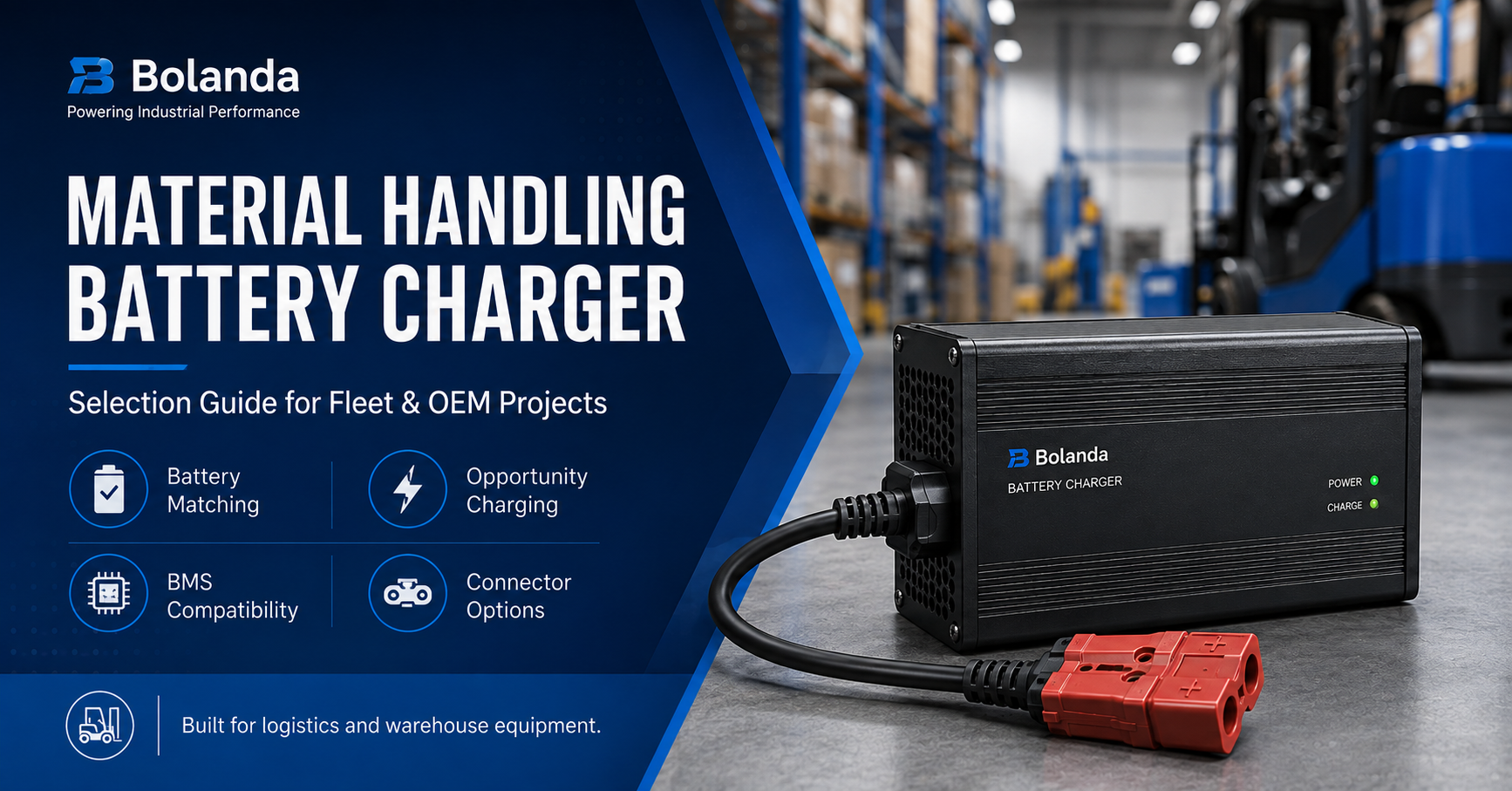
A material handling equipment battery charger operates in a working environment where equipment availability directly affects warehouse and production efficiency.
Applications can include electric forklifts, pallet trucks and other battery-powered logistics equipment. EnerSys identifies forklifts and pallet trucks as major battery and charger applications within warehousing and logistics, while Toyota also treats the battery and charger as part of an integrated forklift energy solution.
That makes charger selection different from purchasing a simple consumer battery accessory.
For material handling equipment, the charger can influence:
- Equipment availability
- Battery turnaround time
- Shift planning
- Charging-area workflow
- Battery temperature
- Connector durability
- Fleet productivity
- Long-term battery management
The correct charger therefore needs to match both the battery system and the operating schedule.
Start With the Battery Chemistry
The first question should be:
What type of battery is installed in the equipment?
Material handling fleets can use different battery technologies, including traditional lead-acid systems and increasingly lithium-ion systems. OSHA's powered-industrial-truck guidance specifically discusses large lead-acid batteries used in electric forklifts, while major forklift suppliers now also provide dedicated lithium-ion battery and charger systems.
These battery technologies should not be treated as interchangeable from a charging perspective.
| Battery Factor | Lead-Acid System | Lithium-Ion System |
|---|---|---|
| Charging profile | Battery-specific lead-acid charging | Battery/BMS-specific lithium charging |
| Battery management | Different management requirements | Typically integrated BMS |
| Opportunity charging | Application dependent | Often well suited |
| Maintenance | May require battery maintenance | Typically lower routine battery maintenance |
| Charging-area considerations | Ventilation and charging procedures can be important | Battery-system-specific safety requirements |
| Charger matching | Battery voltage/capacity/profile | Battery voltage/current/BMS/interface |
The actual battery manufacturer's charging requirements should remain the primary technical reference.
Why Voltage Alone Is Not Enough
A sourcing request such as:
“We need a 48V forklift charger.”
does not fully define the charger.
The manufacturer may still need:
- Battery chemistry
- Nominal battery voltage
- Maximum charging voltage
- Battery capacity
- Maximum charging current
- BMS specification
- Connector type
- Communication requirements
- Intended charging schedule
- Equipment operating environment
Two material handling batteries with similar nominal voltage can require different charger configurations.
For an OEM project, always use the actual battery specification rather than choosing from the voltage number printed on the equipment alone.
Charger-to-Battery Matching Is a Core Fleet Requirement
Battery and charger matching should be considered systematically.
EnerSys describes charger-to-battery matching as one of the factors assessed in its battery and charger maintenance analysis, together with battery-to-truck matching, charger output and batteries per shift.
For B2B buyers, this provides a useful purchasing framework.
The charger should be evaluated against:
Battery electrical requirements
Confirm voltage, capacity, charge-current limits and charging profile.
Equipment utilization
Understand how long each truck or vehicle operates between charging opportunities.
Number of shifts
A single-shift warehouse can have very different charging requirements from a three-shift distribution center.
Charger availability
Determine whether one charger serves one battery or several batteries across different periods.
Battery-to-equipment assignment
Fleet operators should know whether batteries remain dedicated to specific equipment or rotate between machines.
These operational factors can change the preferred charging strategy.
What Is Opportunity Charging?
Opportunity charging means charging a battery during shorter natural breaks rather than relying exclusively on one long charging session.
Examples can include:
- Lunch breaks
- Operator changes
- Shift changes
- Equipment idle periods
- Loading downtime
Lithium-ion material handling systems are particularly associated with this approach. EnerSys describes its lithium-ion systems as optimized for opportunity charging, while Toyota notes that lithium-ion batteries can support faster charging and reduced downtime compared with traditional lead-acid workflows.
Opportunity charging can be valuable where equipment utilization is high.
However, the charger and battery must be specifically suitable for that operating strategy.
Standard Charging vs Opportunity Charging
| Operational Factor | Standard Charging | Opportunity Charging |
|---|---|---|
| Main charging period | Longer scheduled session | Multiple shorter sessions |
| Best suited for | Equipment with sufficient idle time | High-utilization fleets |
| Charger accessibility | Central scheduled charging | Chargers near workflow points may help |
| Battery requirement | Battery-specific | Must support intended charging strategy |
| Fleet planning | Based around long charge windows | Based around available work breaks |
| Charger power | Application dependent | May require higher available charging power |
| Thermal evaluation | Important | Particularly important with repeated charging |
A fleet should not adopt opportunity charging simply because it sounds faster.
Battery specifications, charger capability, BMS strategy and actual equipment usage need to support it.
Charging Current Should Be Based on Fleet Requirements
Higher current can potentially reduce charging time, but maximum current should not be treated as the default goal.
The correct charging current depends on:
- Battery cell limits
- Battery capacity
- BMS charge-current limits
- Charger architecture
- Connector rating
- Cable rating
- Thermal conditions
- Required turnaround time
- Charging frequency
For example, equipment that operates only one daytime shift may have a long overnight charging window.
A high-utilization fleet operating across multiple shifts may place greater value on faster charging.
Toyota highlights reduced charging downtime as one benefit of lithium-ion forklift systems, but this is achieved through a battery-and-charger solution designed for the application rather than simply connecting a higher-current charger.
BMS Compatibility Is Essential for Lithium Equipment
Lithium-ion material handling batteries commonly incorporate battery management controls.
EnerSys describes integrated battery management controls in its lithium-ion material handling systems as supporting safety, reliability and battery life.
Depending on the battery design, the BMS can manage or monitor:
- Battery voltage
- Cell conditions
- Charging current
- Temperature
- State of charge
- Protection conditions
- Communication
- Charge permission
An OEM charger manufacturer therefore needs to understand whether the battery uses only a power connection or requires a more advanced interface.
Useful project information can include:
- BMS specification
- Communication protocol
- Connector drawing
- Pinout
- Battery sample
- Existing charger
- Charge-enable logic
The charger and BMS should be treated as parts of one charging system.
Connector Selection Is Especially Important in Fleet Applications
Material handling equipment can create frequent connection and disconnection cycles.
That makes connector durability an important part of charger design.
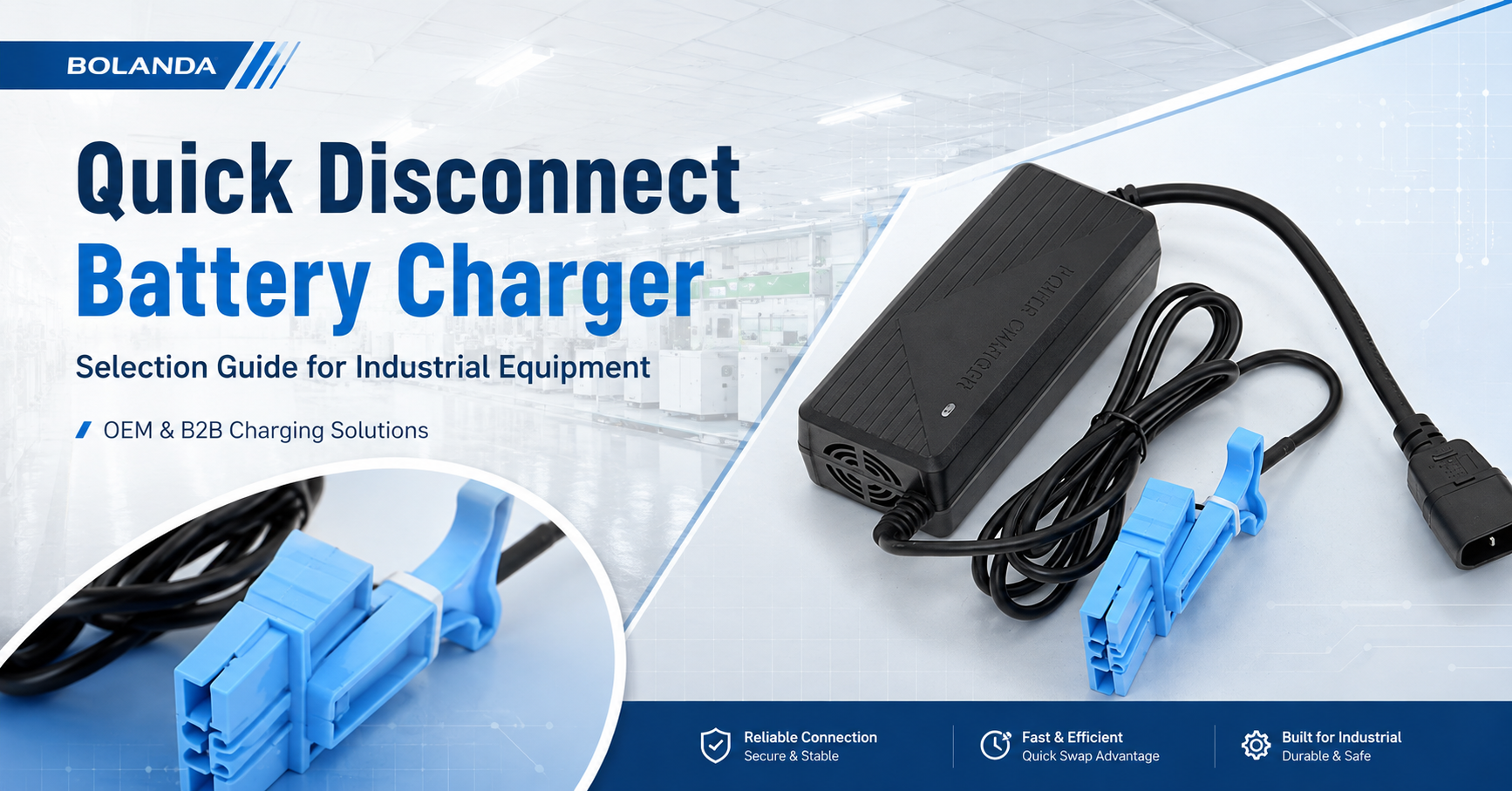
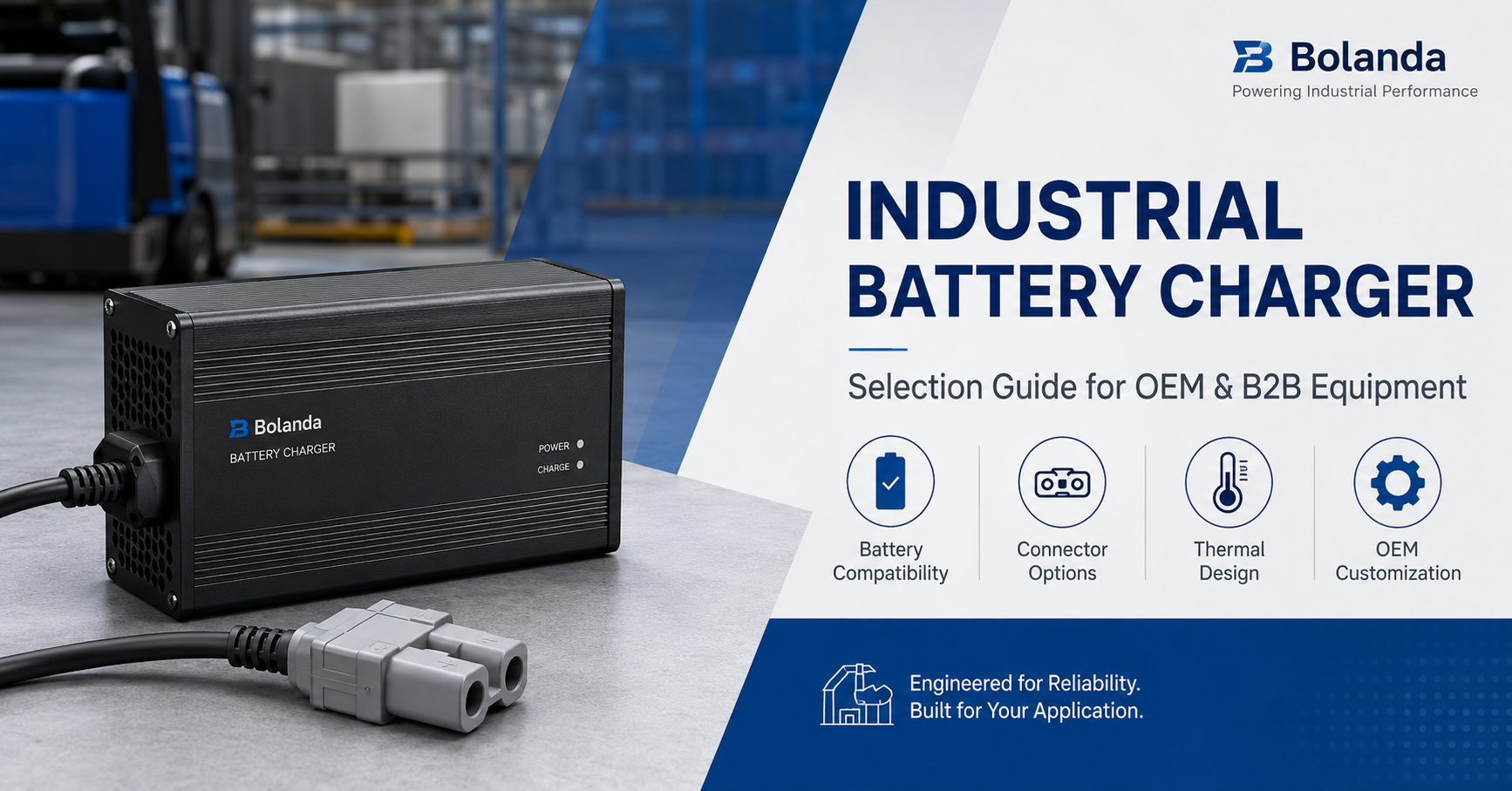
Bolanda currently publishes compact industrial battery chargers with red, gray and blue two-pole connector configurations, including quick-disconnect versions, demonstrating the type of connector variation that can occur across industrial charger projects.
When evaluating a connector, check:
- Polarity
- Current rating
- Voltage rating
- Mechanical keying
- Contact resistance
- Connection-cycle durability
- Cable size
- Strain relief
- Retention
- Operator usability
Connector color should never be treated as a technical specification by itself.
Two connectors that appear similar can have different wiring or performance requirements.
Quick-Disconnect Connectors for Material Handling Chargers
Quick-disconnect connectors can be useful where batteries or equipment need frequent charger connection.
Their potential advantages include:
- Faster connection
- Easier repetitive use
- Defined mechanical mating
- Practical fleet handling
However, buyers still need to verify electrical ratings and actual connector compatibility.
For replacement or OEM charger projects, provide:
- Connector manufacturer or model
- Technical drawing
- Pin assignment
- Cable specification
- Physical sample where possible
This significantly reduces sourcing ambiguity.
Cable Design Should Reflect Warehouse Use
A warehouse charger cable is part of the working equipment.
Depending on the installation, cables can experience:
- Repeated flexing
- Pulling
- Dragging
- Storage cycles
- Connector movement
- Operator handling
Important cable factors include:
Conductor size
It must support the required current.
Cable length
Longer cables can affect voltage drop, handling and installation.
Flexibility
The appropriate construction depends on how frequently the cable is moved.
Strain relief
Mechanical stress should not be transferred directly to internal electrical connections.
Connector termination
The connection between conductor and connector should remain reliable during repeated operation.
Bolanda lists Connector & Cable among the configuration areas reviewed for OEM/ODM electronic-power projects.
Fleet Duty Cycle Changes Charger Requirements
Material handling equipment often runs on defined shifts.
Before specifying a charger, determine:
- Equipment operating hours per shift
- Number of shifts per day
- Battery capacity
- Remaining state of charge after each shift
- Available charging windows
- Frequency of opportunity charging
- Number of chargers available
- Number of batteries per vehicle
- Expected seasonal peaks
A charger for a low-use warehouse vehicle may operate very differently from one supporting high-throughput distribution equipment.
The correct specification should reflect actual daily use rather than only the battery's electrical label.
One Charger per Vehicle or Shared Charging?
Both strategies can work depending on fleet design.
Dedicated charger
Advantages can include:
- Defined charger-to-battery pairing
- Easier equipment management
- Less scheduling complexity
Shared charger
Potential benefits include:
- Reduced charger quantity
- Centralized charging infrastructure
But shared systems require closer review of:
- Battery compatibility
- Charger availability
- Connector compatibility
- Charging schedule
- Fleet peak demand
The lowest charger count does not always create the lowest operational cost if vehicles must wait for charging access.
Charging Infrastructure Should Be Planned Around Workflow
Charger placement can affect fleet productivity.
Questions include:
- Where does equipment naturally become idle?
- Are charging points close to work areas?
- Will cables obstruct traffic?
- Is the charger protected from equipment impact?
- Is there sufficient ventilation where required?
- Are operators trained in connection procedures?
- Is power capacity available at the charging location?
OSHA's powered-industrial-truck guidance states that battery charging installations should be designated for charging and that charging apparatus should be protected from truck damage.
These workplace considerations are separate from charger product selection but can materially affect the success of a charging system.
Lead-Acid Charging Areas Need Specific Attention
For fleets still using unsealed lead-acid batteries, charging-area requirements deserve careful consideration.
OSHA requires ventilation for certain battery installations to prevent accumulation of explosive gases and provides additional requirements around battery charging.
OSHA's forklift guidance also advises shutting the charger off when connecting or disconnecting certain batteries because an arc or spark can create a hazard.
These requirements should not be automatically transferred to every lithium system, because the battery technologies and hazards differ.
Fleet operators should follow the applicable regulations and the battery and charger manufacturers' instructions for their exact equipment.
Thermal Performance Matters in Multi-Shift Operations
Repeated or higher-power charging can increase thermal stress.
Potential heat sources include:
- Power semiconductors
- Magnetic components
- PCB assemblies
- Charger housing
- Connectors
- Cables
- Battery terminals
An OEM charger sample should therefore be tested under conditions similar to the real fleet.
A useful thermal-validation plan can include:
- Maximum expected charging current
- Representative battery state of charge
- Highest expected ambient temperature
- Repeated charging cycles
- Real enclosure conditions
- Actual cable and connector
A short bench test may not reveal conditions that appear during continuous warehouse operation.
Portable vs Fixed Chargers
Material handling applications can use different charger formats.
Portable charger
May be appropriate when:
- Equipment moves between sites
- Charging requirements are flexible
- Charger relocation is necessary
Fixed charger
May be preferable when:
- Charging stations are permanent
- Fleet workflow is stable
- Cable management is centralized
- Higher equipment utilization requires designated charging points
Neither is inherently better.
The choice should follow workflow, power requirements, durability and installation needs.
Battery Charger Safety Should Be System Specific
Safety requirements depend on battery chemistry, charger design, workplace environment and intended use.
OSHA's current guidance for lithium-ion batteries recommends worker training, inspecting batteries and devices, keeping batteries away from high heat and avoiding charging near flammable materials.
For material handling operations, buyers should evaluate both:
Product-level safety
and
Charging-area safety
A technically compatible charger does not replace appropriate workplace procedures.
What Should Be Tested During Sample Evaluation?
Sampling should verify more than whether the battery begins charging.
Electrical Performance
Check:
- Input operation
- Output voltage
- Charging current
- Charging profile
- Charge termination
- Standby behavior
Battery and BMS Compatibility
Use the actual target battery whenever practical.
Confirm:
- Charging starts correctly
- BMS accepts charging
- Required communication works
- Charging terminates correctly
- Fault conditions behave as intended
Connector and Cable
Check:
- Fit
- Polarity
- Cable temperature
- Connector temperature
- Mechanical retention
- Strain relief
- Repeated connection
Thermal Verification
Test representative full or partial charging cycles.
Fleet Simulation
Where appropriate, evaluate the charger using the charging pattern expected in actual warehouse operation.
This can be more informative than a single full-charge test.
OEM Customization for Material Handling Equipment Chargers
Bolanda publicly identifies Logistics Lithium Equipment Chargers as a core product category specifically for lithium-powered logistics and material-handling equipment.
Its published OEM/ODM framework includes several relevant project areas.
Input and Output
Electrical requirements can be reviewed according to the selected charger and application.
Charging Parameters
Charging requirements can be evaluated around the battery system.
Connector and Cable
Connector type and cable configuration can be reviewed for the equipment interface.
Housing and Label
Product identification and housing requirements can be evaluated according to project feasibility.
Plug Standard
Input-side plug requirements can be reviewed according to target-market needs.
Packaging
OEM packaging can be evaluated for the confirmed order.
Exact feasibility should be confirmed for the individual project rather than assumed from the general capability list.
Manufacturing Capability Matters for Long-Term Fleet Projects
A charger used across a fleet needs consistency from one production batch to another.
Relevant manufacturing controls can include:
- SMT assembly
- Through-hole assembly
- Component sourcing
- Cable assembly
- Final assembly
- Functional verification
- Reliability testing
- Change control
Bolanda states that it supports SMT and through-hole assembly for prototypes and production, together with EMS/CM manufacturing and reliability verification.
For OEM equipment manufacturers, this can help connect prototype requirements with later production control.
Quality Control Should Follow the Approved Specification
Bolanda currently describes four stages in its project quality approach:
Material Review
Incoming materials and project-specific components are reviewed before production.
Process Inspection
Production checkpoints are arranged around approved manufacturing requirements.
Product Verification
Functional and reliability verification is defined for the applicable product and project.
Release & Delivery
Final inspection, packing and delivery follow the confirmed order and quality plan.
For fleet chargers, this is important because small uncontrolled changes in connectors, cables or electrical components can affect compatibility across many vehicles.
Material Handling Charger Selection Checklist
| Selection Area | Buyer Question |
|---|---|
| Equipment | Forklift, pallet truck or other logistics equipment? |
| Battery chemistry | Lithium-ion, lead-acid or another chemistry? |
| Voltage | What is the exact battery charging requirement? |
| Capacity | What is the battery Ah or Wh rating? |
| Charging current | What does the battery permit? |
| BMS | Is communication or charge enable required? |
| Connector | Which model, pinout and current rating? |
| Cable | What length and handling conditions? |
| Shifts | How many operating shifts per day? |
| Charging strategy | Full charging or opportunity charging? |
| Fleet size | How many vehicles and batteries? |
| Environment | Warehouse, factory or another location? |
| Thermal conditions | What ambient temperature is expected? |
| Charger placement | Portable, wall-mounted or charging station? |
| Target market | Which region will use the equipment? |
| OEM requirements | Electrical, connector, label or packaging changes? |
This table can also be used as the first page of a charger RFQ.
Common Procurement Risks
Choosing the charger only from truck voltage
Risk: Battery chemistry, BMS and actual charging requirements may not match.
Better approach: Use the battery specification.
Ignoring shift structure
Risk: Charging capacity may not support fleet utilization.
Better approach: Calculate the actual available charging windows.
Assuming faster charging is always better
Risk: Battery, BMS, connector or thermal limits may be exceeded.
Better approach: Select current around the approved battery system.
Choosing the connector by color
Risk: Wiring, current rating or mechanical design may differ.
Better approach: Use a drawing, specification or physical sample.
Ignoring charger placement
Risk: Cables and equipment can interfere with warehouse traffic or become damaged.
Better approach: Design the charging area around actual workflow and applicable safety requirements. OSHA recommends protecting charging apparatus from damage and maintaining designated charging arrangements.
Assuming one charger configuration works for the whole fleet
Risk: Different batteries or equipment generations may have different requirements.
Better approach: Build a charger-to-battery compatibility matrix.
What Should Be Included in the RFQ?
| RFQ Item | Information to Provide |
|---|---|
| Equipment | Forklift, pallet truck or other equipment |
| Battery chemistry | Exact chemistry |
| Nominal voltage | Battery platform |
| Maximum charging voltage | Required charging limit |
| Capacity | Ah or Wh |
| Charge current | Target and maximum |
| BMS | Interface and communication requirements |
| Connector | Model, drawing, pinout or sample |
| Input | AC voltage and frequency |
| Charging strategy | Full charge or opportunity charging |
| Operating shifts | Number and duration |
| Fleet size | Number of vehicles and batteries |
| Environment | Charging location and temperature |
| Cable | Length and construction |
| Housing | Portable or fixed requirement |
| Target market | Country or region |
| Quantity | Sample and production forecast |
Bolanda's current quotation guidance asks buyers to provide product type, input and output requirements, battery information, connector, expected quantity and target market.
For material handling projects, adding fleet duty-cycle information makes that RFQ even more useful.
Frequently Asked Questions About Material Handling Equipment Battery Chargers
What battery charger do I need for a forklift?
Use a charger matched to the exact forklift battery chemistry, charging voltage, capacity, permitted charging current, BMS and connector. Forklift voltage alone is not sufficient.
Can the same charger be used for several forklifts?
Potentially, but only if the batteries are compatible with the charger specifications and connector. Shared-charger scheduling must also support the fleet's operating hours.
What is opportunity charging?
Opportunity charging uses shorter charging periods during normal equipment downtime such as breaks or shift changes. Lithium-ion material handling systems are commonly designed to take advantage of this approach.
Are lithium forklift batteries faster to charge?
Lithium-ion forklift systems can support substantially faster charging than traditional lead-acid workflows when paired with the appropriate charger. Toyota specifically highlights faster recharge and reduced downtime among the operating benefits of its lithium-ion solutions.
Does a lithium material handling battery need a BMS-compatible charger?
The charger needs to meet the requirements of the battery and its BMS. Depending on the system, this can involve electrical limits, charge enable or communication.
Can the charging connector be customized?
Bolanda lists connector and cable requirements as one of its OEM/ODM configuration areas. Final compatibility and customization feasibility depend on the selected charger and battery system.
Does Bolanda support logistics equipment chargers?
Yes. Bolanda currently identifies Logistics Lithium Equipment Chargers as one of its five core electronic-power product categories and describes them as charging solutions for lithium-powered logistics and material-handling equipment.
Can charging current be customized?
Charging parameters can be evaluated as part of Bolanda's OEM/ODM project process, but feasibility depends on the battery, charger platform, connector, thermal design and confirmed project requirements.
What information is most important before requesting a quotation?
Battery chemistry, charging voltage, capacity, current, BMS, connector, equipment application, fleet size, shift pattern, charging strategy and target market are particularly useful.
Is the lowest-price charger the best option for a fleet?
Not necessarily. Fleet buyers should also consider battery compatibility, charging time, equipment downtime, connector durability, quality control, reliability and long-term component consistency.